Post-handoff maintenance is the work of running, changing and recovering a system after the team that built it has stepped back. It needs a named owner on your side, a written scope, proof that your people can operate the system without help, and a fixed rhythm of routine work. If any of those four is missing, the handoff has moved files but not responsibility.
This guide is for founders, COOs and heads of Finance, Sales and Customer Success at B2B SaaS companies who are about to receive, or have just received, a custom system, an integration layer or AI agents. It covers who owns what, what to verify before the builder leaves, and what to schedule afterward. At NordOps Consulting, source code, documentation and infrastructure transfer to you at handover, so this plan assumes you own the result and need to keep it healthy.
TL;DR
- Handoff is complete when your team can operate, change and recover the system, not when files have been sent.
- Name one business owner for the outcome and a technical owner for the running system. Write down who covers incidents, changes and exceptions.
- Verify by doing: your people deploy, roll back, restore a backup and answer a live support issue before the builder’s access ends.
- Run maintenance as four separate queues with different urgency: incidents, platform deadlines, dependency expiry and product changes.
- Keep AI agents inside defined permissions, with approval and an audit trail, and keep people in charge of decisions that carry legal or financial weight.
Table of Contents
- What post-handoff maintenance actually covers
- Who should own it
- The handover checklist: what must transfer
- Write the maintenance plan before the builder leaves
- Prove the handover by doing
- Maintenance rhythm that works for a SaaS team
- Where AI does not belong in maintenance
- Common mistakes after handoff
- Our perspective
- How we hand over and support what we build
- FAQ
- Sources
What post-handoff maintenance actually covers
Maintenance is not one job. A useful way to split it is into four duties for a live system:
- Running it: monitoring, incident response and recovery.
- Building for continued use: knowing how changes are made, monitored and reversed.
- Preserving business knowledge: recording unusual rules and the reasons behind decisions.
- Improving it: spotting recurring problems that deserve priority.
These often sit with different people, and a development contract does not automatically include incident response, just as an operations agreement does not automatically include improvement. Shinetech makes this distinction in a September 2026 article. If you do not assign each duty, each one defaults to nobody.
For a SaaS company the stakes are practical. A CRM sync that stops quietly corrupts the revenue numbers Finance reports. A broken provisioning flow leaves new customers without access. An AI agent reading stale data gives confident wrong answers. Maintenance is what keeps the data foundation trustworthy after the people who built it are gone.
Who should own it
Split accountability from execution.
- Business owner: responsible for the outcome the system supports, such as accurate billing data or on-time customer onboarding. This person approves priorities and spend. In a company of 20 to 200 people it is usually the COO, or the head of the department that uses the system most.
- Technical owner: responsible for infrastructure, application code, integrations and third-party services. This can be an internal engineer, a small team, or an external maintainer under a written agreement.
- Backup owner: the person who decides and acts when the primary owner is unavailable. Naming an operations owner, defining escalation routes and identifying that backup is the core of a clean transition.
If your team uses AI but nobody owns it, this is the same gap in another form. An AI agent can help a maintainer, but giving a task to a model does not create a person who answers when the service fails. Someone with a name must be able to notice a failure, decide what to do, fix it and confirm users can work again.
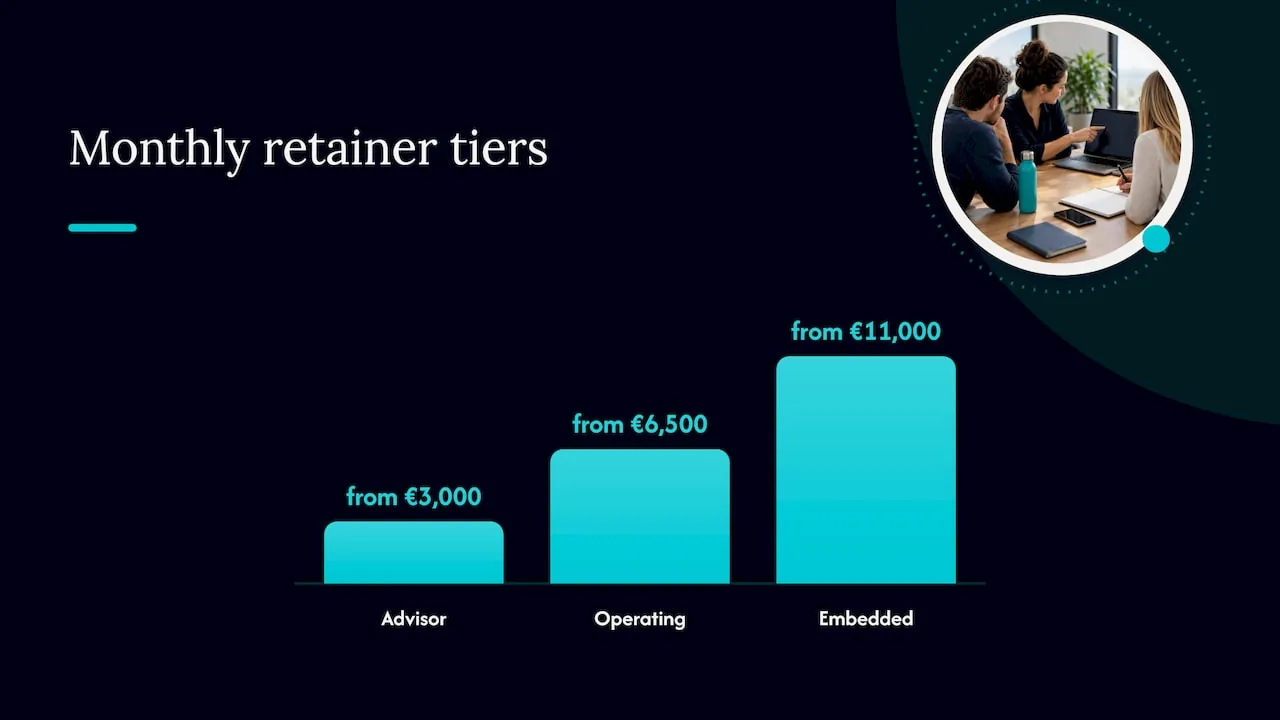
Smaller companies often cannot justify a full-time executive for this. That is the case for a part-time senior owner. Our Fractional Chief AI Officer retainer starts from €1,500 per month (Advisor level), with Operating from €3,250 per month and Embedded from €5,500 per month. It gives you one named person who owns AI decisions and the systems behind them.
The handover checklist: what must transfer
A repository is not a handover. The system lives in accounts, environments, schedules and habits around the code. Before the builder steps back, confirm each of these exists in writing and that someone on your side has seen it work.
Code and build
- Full repository with history, plus instructions that let your team build and test from scratch.
- Source code ownership stated in the contract. With our builds, source code, documentation and infrastructure transfer to you at handover.
Infrastructure and accounts
- Environments (development, staging, production), domains, hosting, billing and integrations, each with a named owner on your side.
- Root accounts under your company’s control, not an individual’s inbox.
- Where secrets are managed and how authorized access works. Secret values do not belong in ordinary documents or source code.
Operating context
- Deployment steps, rollback steps, monitoring, alerts, dashboards, scheduled jobs, data retention and recovery expectations.
- Which external services the system calls and what happens when they fail.
Data and architecture
- A data-flow diagram showing which system is the source of truth for each record type. For most SaaS companies that means the CRM for customer and pipeline data and the finance system for billing data.
- Any unusual business rules, with the reason they exist.
Known issues and exceptions
- A list of open bugs, temporary fixes, technical debt, renewals and manual deadlines, each with an impact, an owner and a target date.
If your system includes the AI layer, add three items: which assistant connects to which data, what each agent is allowed to read and change, and where the audit trail is stored. Our How It Works page describes the order we build in: data foundation first, then the AI layer, then department agents. The handover documentation follows the same order, so you can maintain each layer separately.
Write the maintenance plan before the builder leaves
A maintenance plan is a short document, not a policy binder. It should record:
- Scope: which applications, environments and integrations are covered.
- Authority: who sets priorities and who accepts finished work.
- Incident coverage: hours, escalation path and response windows.
- Capacity: how many hours or days per month are available.
- Release duties: who deploys, who tests, who can roll back.
- Additional work: how requests outside the plan are estimated and approved.
The last point causes most disputes. If the plan does not say how extra work is quoted and approved, every request becomes a negotiation. Managed IT support providers describe the same scoping questions for ongoing and additional work, and the logic carries over to software: define what the retainer covers, then price everything else separately.
For reference, our maintenance is optional and billed monthly by retainer. You can also run the system with your own people. Source code and documentation are yours either way, and nothing in the build depends on a subscription.
Sort work by urgency, not by arrival
Not every problem deserves the same response. Rank by commercial impact, number of affected users and whether a workaround exists. A billing export that fails on the last day of the month is urgent. A cosmetic issue in an admin screen is not.
It also helps to treat maintenance as four queues:
| Queue | Typical notice | Who usually owns it |
|---|---|---|
| Incidents | Hours | The named on-call owner |
| Platform deadlines (API changes, vendor requirements) | Months | Often nobody, so assign someone |
| Dependency end-of-life | Years | Often nobody, so assign someone |
| Product changes | Planned | The roadmap owner |
The queues with the most warning tend to get the least attention, because nobody is paged. Give each one a named owner and a calendar review.
Prove the handover by doing
Documents do not prove capability. The final review should be a working session in which your people do the tasks while the builder watches and answers questions without quietly doing the work.
- Shadow, then reverse shadow. First your team watches the builder handle real work. Then your team performs it while the builder observes and records every point where they needed help. Each point is a gap to document and test again.
- Build and deploy. Your maintainer clones the repository, builds from the written instructions and deploys to a non-production environment.
- Release and roll back. Your team releases a small change to production and reverses it.
- Restore. Your team restores a backup and confirms the data is intact.
- Alert path. Send a test alert and confirm it reaches a named person. A dashboard nobody watches is not coverage.
- Live issue. Your team diagnoses a real or simulated support issue using logs and monitoring, without help.
- Access check. Verify each permission using your team’s own accounts. Remove the builder’s access only after replacement responsibilities and dependencies are confirmed.
Operating the system independently is also the test of your hosting arrangement. Comparing managed hosting options is one way to check whether you need outside help for the infrastructure side. Ask whether your team can run, scale and recover the environment on its own.
Close with acceptance, not goodwill
Operational acceptance should be confirmed against scope, access, materials, support path and documented exceptions, and each unresolved item should have a named owner and a target date. Keep launch acceptance (the software works) separate from handover acceptance (your team can run it). Agree a support window from the builder, so the first weeks have a safety net.
Maintenance rhythm that works for a SaaS team
After acceptance, a simple cadence keeps the system from drifting:
- Weekly: review errors, failed jobs and the open backlog.
- Monthly: apply dependency updates and security patches; check that integrations still return the data Finance, Sales and Customer Success expect.
- Quarterly: run a restore test and audit who has access to what.
- Twice a year: review the architecture against how the business has changed.
This cadence matters more as the system gets closer to customer data. GDPR asks controllers and processors to put appropriate technical and organisational measures in place for security of processing, taking account of risk. A regular access audit, tested backups and working alerts are the kind of routine evidence a security review looks for. They do not by themselves guarantee compliance, and for questions about your obligations you should speak to your data protection officer or legal counsel.
What changes when AI agents are part of the system
Agents add a few maintenance duties on top of normal software:
- Permissions review. An agent that can update records or provision access should have the narrowest rights it needs. Review them on the same quarterly schedule as human access.
- Approval rules. Actions with financial or contractual weight, such as issuing credits or changing a price, should keep a human approval step.
- Audit trail. Confirm every read and write is logged and that someone looks at the log.
- Data quality. An agent is only as accurate as the CRM and finance records it reads. If the data foundation drifts, the agent’s answers drift with it.
The EU AI Act sets rules for AI systems by risk category, including obligations on those who use them. Which ones apply to you depends on what the system does, so check the regulation’s text with your counsel. NIS2, the EU’s network and information security directive, can also affect software companies depending on their size and sector. We treat all three as design requirements, not as a final-stage checklist, and we do not give legal advice.
Where AI does not belong in maintenance
Be explicit about the limits:
- Accountability. An agent cannot be the named owner of a production service. A person answers when it fails.
- Unattended changes to production. AI can draft a patch or summarize an incident. A person reviews and approves the release.
- Judgment calls with legal or financial weight. Refunds, contract terms, data deletion and regulatory notices stay with people.
- Messy source data. If the CRM and finance records disagree, fix the data first. Adding an agent on top produces faster wrong answers.
- Processes nobody has mapped. Adopt AI one process at a time, starting with the most expensive one, after you can describe how it works today. Our guide to service blueprinting shows how to map a process from both sides, and the piece on change management automation covers what to automate and what to keep human.
Common mistakes after handoff
- Treating repository transfer as the whole job. Accounts, billing, domains and recovery knowledge matter as much as code.
- Letting the builder’s access linger or vanish too early. Both leave a gap. Remove it on a planned date after verification.
- No owner for slow deadlines. Vendor API changes and end-of-life dates arrive with months of warning and still get missed.
- Documentation that is never updated. Assign the technical owner to update runbooks whenever something changes, and use one page per service so it stays easy to find.
- Skipping the restore test. A backup nobody has restored is an assumption.
Our perspective
We build the foundation, the AI layer and the agents, and then we hand all of it to you. That only works if the handover is designed from the first week, not written in the last one.
The most common failure we see described in this field is a strategy owned by one party and a working system owned by another, with a gap between them. Our model is one named person, a Fractional Chief AI Officer with 25 years of operational leadership, who decides where AI pays and also builds it. Strategy and the working system stay close because the same person is responsible for both.
That is why the order matters. Clean CRM and finance data as the source of truth makes maintenance simpler, because every agent reads the same agreed version. Documentation, source code and infrastructure that transfer to you mean you are never waiting on us to change your own system. You can maintain it with your people, or add an optional monthly maintenance retainer.
Our advice: do not accept a handover you have not operated yourself. Deploy it, break it, restore it, and only then close the project.
Claus Nielsen
How we hand over and support what we build
Builds start with a fixed price agreed before work begins, or a fee of 30% of the first-year saving, once measured and proven. Because the client owns what is built, the handover covers source code, documentation and infrastructure. Build, pilot and testing run on self-hosted European infrastructure in Germany, so the environment your team inherits is one built around GDPR, NIS2 and the EU AI Act as design requirements.
If you are not sure your current setup would pass the checks above, a good first step is the AI Readiness Assessment, from €4,500 one-off. For a quicker view, the AI Snapshot is a one-off service at €2,500 to €3,500. You can also start with the free 30-minute discovery call.
To see what the finished system looks like for your finance, sales and customer success teams, read about our AI agents for Finance, Sales and CS, or contact us through NordOps Consulting.
FAQ
When is a software handoff actually complete?
It is complete when your team can operate, change and recover the product, not when files have been delivered. In practice that means they have deployed, rolled back and restored a backup on their own, and every open item has an owner and a date. Until then the builder is still carrying responsibility.
How long should the builder stay available after handover?
Agree a support window in writing before the project closes. The length depends on system complexity and how much your team shadowed during the build. Use the window to catch the gaps that only appear in live use, and record each one in the runbook.
Do we need a maintenance retainer?
Not necessarily. If you have a technical owner with time and the documentation is complete, you can run the system yourself. A retainer makes sense when nobody on your team has capacity for incidents, patching and platform deadlines. Our maintenance is optional and billed monthly by retainer.
Who owns an AI agent after it goes live?
A named person in your company does, usually a business owner for the outcome and a technical owner for the running system. The agent works within permissions, with approval where needed and an audit trail, but it does not hold responsibility. Review its permissions and logs on a fixed schedule.
Sources
- Shinetech: Who Owns Your Software After Launch?
- ONES: How to Transfer Ownership of Accepted Software Deliverables
- Comms Circle: Small Business IT Support in London
- Compare UK Hosting: Best Managed Hosting UK
- GDPR Article 32: Security of processing
- EU Regulation 2024/1689 (AI Act), EUR-Lex