If someone else writes software for your company, you do not own it by default. In the US, the UK and Germany, the author generally holds the copyright unless a written contract moves it to you. Source code ownership is settled by the contract: an assignment of rights, access to the repository and infrastructure, and a clear line on your data and on AI-generated code.
This guide is for founders, COOs and heads of Finance, Sales and Customer Success at B2B SaaS companies in Europe who are about to pay for custom systems, AI agents or automations. It explains what ownership means, where it breaks, and what to ask for before work starts. It is general information, not legal advice. Have your own lawyer review the contract.
TL;DR
- Default rule: a contractor or agency usually owns the code it writes. You own it only if the contract assigns it to you in writing.
- Assignment is not a license. A “perpetual license” lets you use the code. It does not make you the owner.
- Ownership has four parts: copyright, the code itself, repository access and the right to run the software. A contract has to cover each one.
- AI-written code is a gray area. In the US, purely AI-generated material is not protected by copyright, so human contribution and your tool terms matter.
- Your data is separate from your code. Write down who owns, exports and deletes it, and whether anyone may train AI on it.
Table of Contents
- What source code ownership actually means
- Assignment versus license
- Who owns code by default
- The four checks before you sign
- Who owns code written by AI
- Your data is not your code
- Where this goes wrong in practice
- What owning your system looks like with us
- Where AI does not belong
- Our perspective
- Starting from a clear picture
- FAQ
- Sources
What source code ownership actually means
Source code is the human-readable instructions a developer writes. Copyright in it is the legal right to control copying, modification and distribution. The Open Source Initiative explains that this right protects the code’s expression, not the ideas or algorithms behind it, and that it arises automatically when the code is created, with no registration.
That last point is why the author matters. Whoever writes the code starts as its owner. Everything else is a transfer or a permission granted by that owner.
It helps to separate four things that buyers often treat as one:
- Copyright ownership: the legal title to the code.
- Possession of the source code: you hold a copy you can read and build from.
- Repository and infrastructure access: you control where the code lives, the cloud accounts, the deployment credentials and the documentation.
- A license to run the finished software: permission to use the compiled product.
You can have one without the others. A company can legally own the copyright and still be unable to change anything because the supplier holds the repository and the hosting account. The reverse also happens: you hold a copy of the code but have no right to modify or resell it. When we talk about owning your software, we mean all four.
Assignment versus license
An assignment transfers ownership of identified rights. A license gives permission to use the work on stated terms while the owner keeps title. A license can limit copies, territory, sublicensing, modification or commercial use.
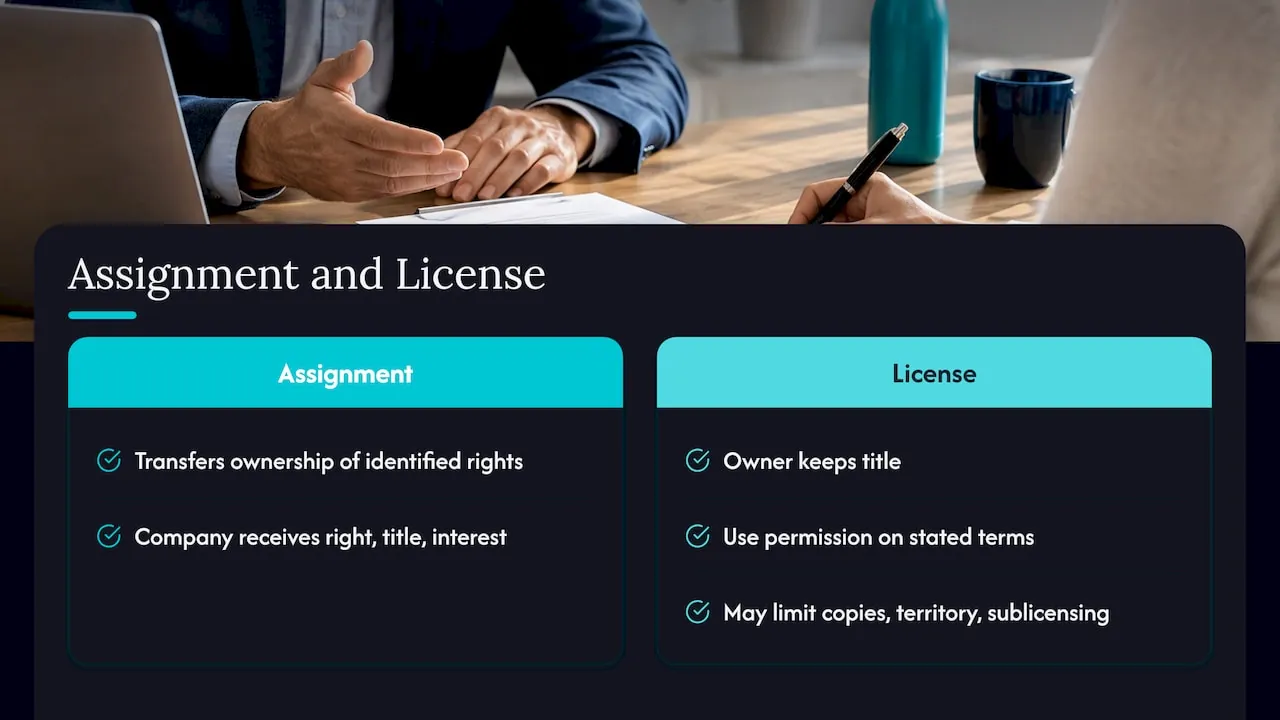
The wording is the whole difference. According to Mister Wolf Law’s guide to code ownership disputes, a clause granting a company a perpetual, worldwide license leaves the developer as owner, free to license the same code to others, including your competitors. A clause in which the developer assigns all right, title and interest to the company transfers ownership.
When you read a draft contract, check which verb it uses. “Licenses” and “grants the right to use” are not “assigns.” If a sales deck says “you own your system” and the contract says “perpetual license,” the contract wins.
Who owns code by default
Employees
In general, code an employee writes as part of the job belongs to the employer. Mister Wolf Law describes this for the US as a work made for hire. The EU rule is similar in effect: under Directive 2009/24/EC on computer programs, when an employee creates a program in the execution of their duties or on the employer’s instructions, the economic rights go to the employer unless the contract says otherwise. Member states implement the details, so check your own country’s law.
Contractors and agencies
This is where companies get caught. Orrick’s guide to assignments from software developers states that UK contractors own their work absent an assignment, that French contractor IP requires an express assignment, and that in the US contractors own the copyright absent a written assignment. In Germany the individual author holds copyright, with employee usage rights vesting in the employer.
A+O Shearman’s September 2024 guide reaches the same default for the UK, Germany, China and the US: IP developed by a contractor is owned by the contractor, while an employee’s work is generally owned by the employer.
In the US, “work made for hire” for a contractor applies only to certain statutory categories and needs a signed agreement. Orrick recommends combining that language with a present assignment, and adding a waiver of moral rights where local law allows it. Orrick also cautions against one-size-fits-all templates for international teams, because what a contractor can assign and the formalities required differ by country. If you work with developers in several European countries, have counsel confirm each contract.
The four checks before you sign
Whatever the supplier, run the contract through these questions.
| Question | What a safe answer looks like |
|---|---|
| Who owns the copyright? | A written assignment to your company, using words of present transfer, not a license. |
| What exactly is assigned? | Source code, documentation, configurations and agent or workflow definitions, all named in the contract. |
| Where does the code live? | In a repository and cloud account in your name, or transferred to you at handover. |
| What did the supplier bring with it? | A list of pre-existing tools, libraries and open-source components, with their license terms. |
Two points deserve extra attention.
Pre-existing and third-party components. Suppliers often reuse their own frameworks. The contract should say whether those are assigned or licensed to you, and on what terms. Open-source components carry their own licenses, and some of those impose obligations on what you build with them.
Handover. Ownership on paper means little if the code, deployment credentials and runbooks stay with the supplier. Ask what is delivered, in what form, and when. Ask who can deploy a change on the day after the engagement ends.
Who owns code written by AI
Most development teams now use AI coding tools, and that raises a fresh question: can anyone own the output?
In the US, the answer is limited. The US Copyright Office’s January 2025 report on copyrightability covers the protection of outputs created using generative AI, and its position is that human authorship is required. Purely AI-generated material is not protected, prompts alone do not make a user the author, and AI-assisted work with real human creative control may be protected case by case. Other countries are still working through their own positions, and the EU AI Act adds separate transparency duties for general-purpose AI providers.
For a SaaS company, the practical consequences are:
- Ask how AI is used in your build. If a supplier’s developers use AI tools, your contract should say so and say who reviews and edits the output.
- Keep a record of human contribution. Design decisions, reviews and edits by named people are your evidence of authorship.
- Check tool terms. Some tools assign output rights to you; some do not. Terms differ by vendor and plan.
- Protect confidential code. Pasting proprietary code into a public model can expose trade secrets, so use tools whose terms keep your inputs private.
AI-generated code also means AI-generated uncertainty. If the ownership of a core module matters to your valuation or to an acquirer’s due diligence, ask your lawyer to review how it was produced.
Your data is not your code
The other half of “who owns what” in SaaS is data. A system you own outright can still be useless if you cannot get your data out of it, or if a vendor may use it in ways you did not agree to.
Contracts for SaaS tools should state who owns customer inputs, prompts and outputs, and how you can export and delete your data. BCLP’s guidance on reviewing SaaS agreements in the age of AI recommends specifying use rights for customer input data, prompts and AI-generated output, since ownership can be allocated by contract. Venable makes a related point: where a SaaS tool uses AI, deliverables may be protected only by contractual rights rather than copyright, so the agreement should address AI use explicitly.
In Europe, personal data in your CRM and finance systems also falls under GDPR. In general terms, that means you need to know where the data is stored, who processes it and under what agreement. Your lawyer or data protection officer should confirm what applies to you.
A useful data checklist for any vendor or builder:
- Who owns customer data, and who owns derived data such as reports and AI outputs?
- Can you export everything in a usable format at any time?
- What happens to the data when the contract ends?
- May the supplier use your data to train AI models?
- Where is the data stored and processed?
Where this goes wrong in practice
Three patterns come up again and again in growing SaaS companies.
The agency built it, nobody assigned it. A project finishes, the invoice is paid, and two years later the company wants to sell or raise money. Diligence finds no assignment. The company has, at best, an implied license to use the software for the purpose it was built for.
The license that looks like ownership. The contract grants a perpetual license. It reads well in a sales meeting. It restricts modification and transfer, and the supplier can reuse the code elsewhere.
Ownership without control. Everything is assigned, but the repository, cloud account and credentials sit with the supplier. You own the title and depend on them for every change.
The first two are fixed by the contract. The third is fixed by how the work is delivered.
What owning your system looks like with us
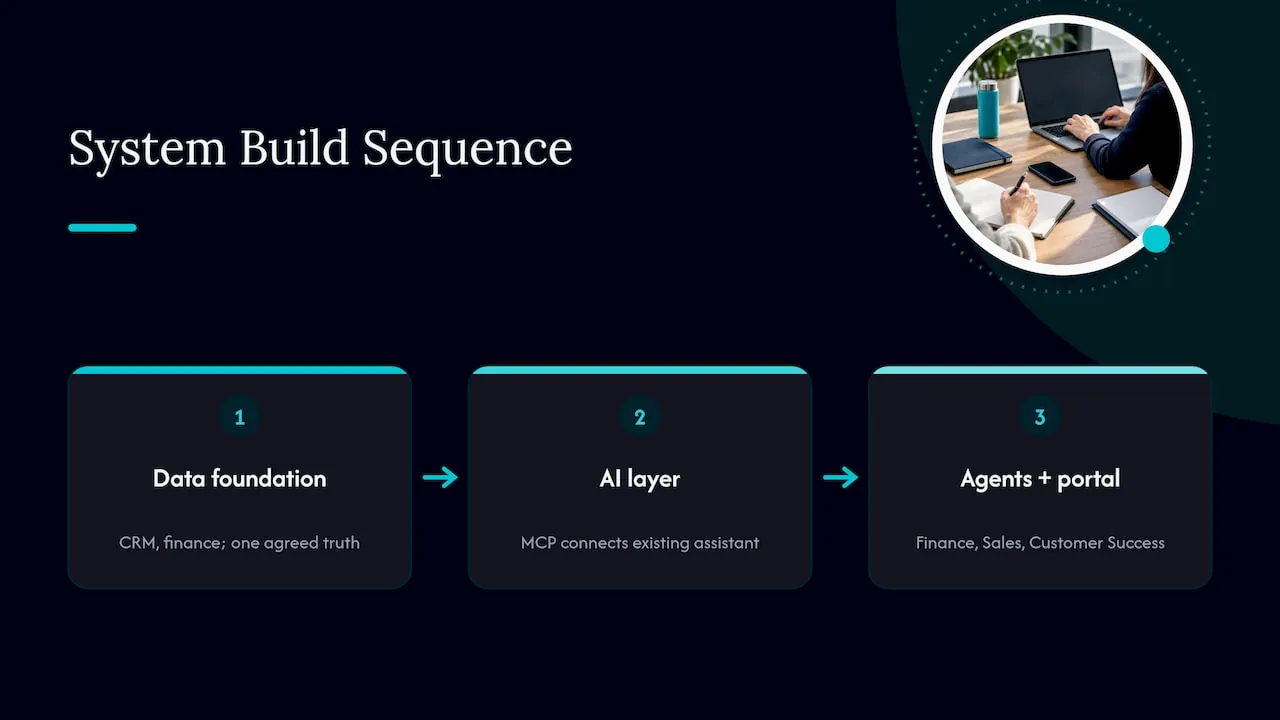
We build operational systems in a set order. First the data foundation: your CRM and finance data as the source of truth, with a Processor that turns it into one agreed version. Then the AI layer, where MCP connects that data to the AI assistant your company already uses. Then purpose-built agents for Finance, Sales and Customer Success, with an Admin Portal alongside.
You own what is built. The source code, documentation and infrastructure transfer to you on the terms set in your contract, and there are no subscription fees. Optional maintenance is a separate monthly retainer. During build, pilot and testing, we run on self-hosted European infrastructure in Germany, and GDPR, NIS2 and the EU AI Act are design requirements from day one. None of that guarantees compliance, which depends on how you run the system and on your own legal review. It does mean the system is designed with those rules in view. How It Works lays out the sequence, and our piece on custom operational software hosted and owned in the EU goes deeper on hosting.
The pricing model fits ownership too. A build is either a fixed price agreed before work starts, or 30% of the first-year saving, once measured and proven. You are not paying for a license that renews. You are paying for something that transfers to you.
Where AI does not belong
Owning a system is also a reason to be selective about what goes into it. AI is a poor fit when:
- The data is unreliable. If the CRM and finance records disagree, an agent will read the wrong version faster. Fix the data foundation first.
- The decision needs accountable judgment. Pricing exceptions, credit decisions and anything touching people’s rights should keep a named human approver.
- The process is cheap or rare. If a task costs little or happens twice a year, automation rarely pays. We start with the most expensive process.
- Nobody owns the output. An agent without an owner, permissions and an audit trail is a liability, not an asset.
Our perspective
We have run operations for 25 years, and the pattern is consistent: companies lose control of their systems at handover, not at build. The code works, the invoice is paid, and then it turns out that the repository, the hosting and the know-how all stay with whoever wrote it.
That is why we treat ownership as part of the design. One person decides where AI pays, makes your CRM and finance data the source of truth, and builds the agents your team uses in plain language. You get the source code, the documentation and the infrastructure, so the strategy and the working system do not drift apart, and you are never dependent on us to change your own system.
Before you sign with anyone, ask for the assignment wording, the delivery list and the data terms in writing, and have your lawyer read them.
Claus Nielsen
Starting from a clear picture
If your team already uses AI but nobody owns it, the first step is to see where it is used, what data it touches and what you would be able to take with you if a supplier left. Our AI Readiness Assessment, from €4,500, maps exactly that. If you want a named person to own AI on an ongoing basis, the Fractional CAIO retainer starts from €1,500 per month. To talk through a specific build, book the free 30-minute discovery call through our contact page.
Full details on how builds are priced are on our pricing page.
FAQ
Who owns source code if a company hires a developer?
If the developer is an employee and writes the code as part of the job, the employer generally owns it. If the developer is a contractor or agency, the default in the US, UK and Germany is that the contractor owns it. A written assignment moves ownership to you.
Is a perpetual license the same as owning the code?
No. A license permits use on set terms, and the licensor keeps title. It may restrict modification, transfer and sublicensing. Ownership requires an assignment of rights, plus control of the repository and hosting so you can actually change and run the code.
Who owns code written by AI?
It depends on the country and the human input. In the US, the Copyright Office’s January 2025 report says purely AI-generated material is not protected and prompts alone do not make you the author. Human creative control over AI-assisted work can be protected. Ask your lawyer about your jurisdiction.
Do I own my data in a SaaS product?
Only as far as the contract says. Look for who owns your inputs and outputs, how you can export and delete data, where it is stored, and whether the vendor may use it to train AI. Under GDPR, personal data in your CRM and finance systems also carries its own obligations.
Sources
- What is copyright? Open Source Initiative
- Software Licensing Disputes, Mister Wolf Law
- Directive 2009/24/EC on the legal protection of computer programs, WIPO Lex
- Intellectual Property Assignments from Software Developers, Orrick
- How to capture IP created by employees and contractors, A&O Shearman
- Copyright and Artificial Intelligence, US Copyright Office
- Reviewing SaaS agreements in the age of AI, BCLP
- Handling IP Rights in SaaS Contracts, Venable