A good pilot project strategy answers one question: should this go into production, yes or no? It does that with one process, a small group of real users, a baseline measured beforehand and a decision date fixed before launch. For a SaaS company with 20 to 200 people where teams already use AI but nobody owns it, the strategy has one more requirement: a named owner who decides which process is worth piloting, and who makes sure the data the pilot reads is correct. At NordOps Consulting, that owner is the Fractional Chief AI Officer role we provide.
This guide covers what a pilot is, how to scope and plan one, how to run it, how to decide at the end, and what to check under GDPR and the EU AI Act along the way.
TL;DR
- A pilot is a small-scale test of one process with real users and real data. Its job is to prove value and expose problems before you commit serious budget.
- Pick the most expensive process you can measure, set the baseline and the success criteria before launch, and put a named business owner on the outcome.
- Fix the decision date and the three possible outcomes (scale, revise, stop) in advance. A pilot with no stop rule is a permanent experiment.
- Get the data foundation right first. An agent that reads inconsistent CRM and finance data produces inconsistent answers, however good the model is.
- Treat GDPR, NIS2 and the EU AI Act as design requirements from the first week, not as a review at the end.
Table of Contents
- What a pilot project is, and what it is not
- Start with the data, then the process
- How to choose the process to pilot
- Building the pilot plan
- Running the pilot
- Deciding: scale, revise or stop
- From pilot to production
- GDPR, NIS2 and the EU AI Act in a pilot
- Common mistakes
- Our perspective
- How NordOps Consulting can help
- FAQ
- Sources
What a pilot project is, and what it is not
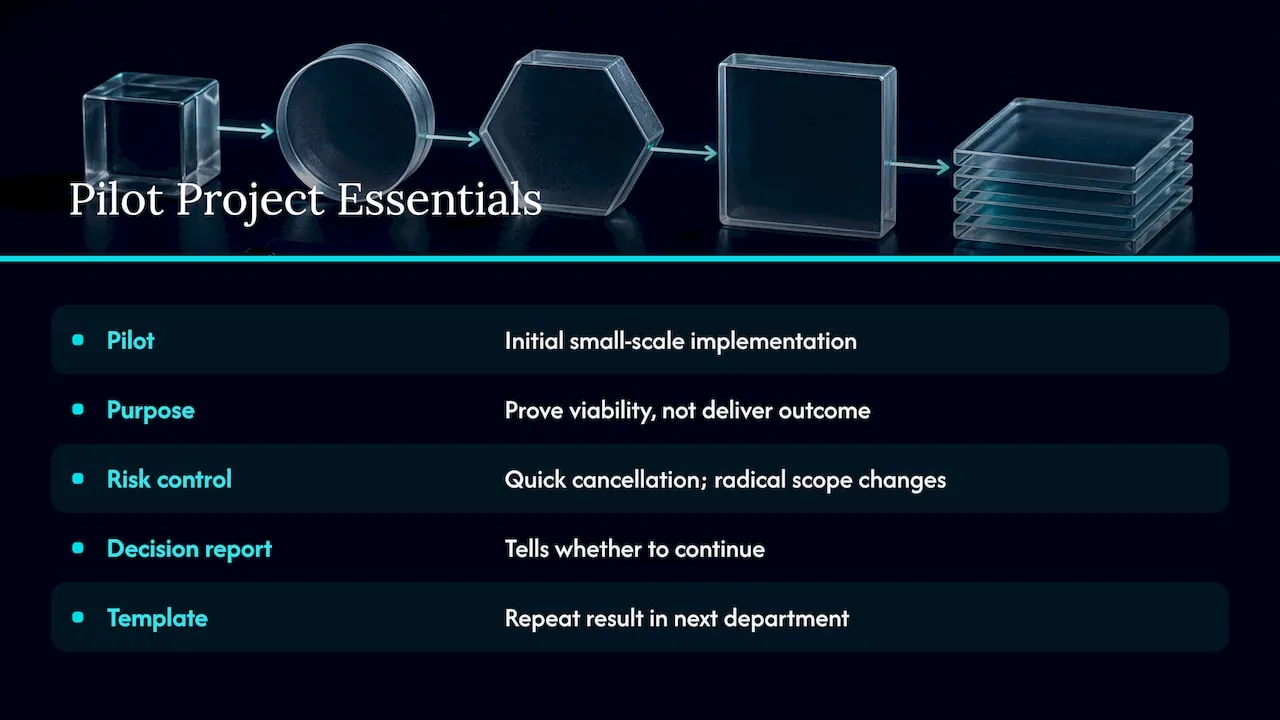
The Association for Project Management describes a pilot as an initial small-scale implementation used to prove the viability of an idea. It lets an organization manage the risk of something new and find deficiencies before substantial resources are committed. The same briefing makes a point that matters for AI work: a pilot carries high uncertainty. Both the team and the people governing it must accept that the purpose is to prove viability, not to deliver an agreed outcome. That means a control structure that allows quick cancellation and radical changes of scope.
The Project Management Institute lists the typical outputs of a pilot: a feasibility study, a yes-or-no business decision report, a usable product, service or process, and a template to replicate. For an AI pilot, the decision report and the template matter most. The first tells you whether to continue. The second lets you repeat the result in the next department.
Pilot versus proof of concept
A proof of concept asks whether something can work technically: can the agent connect to your CRM, read the invoice format, return a sensible answer on sample data? A pilot asks whether it delivers value when real people use it on real work. In most SaaS companies the technical question is answered quickly. The value question is where time and money are lost, which is why the pilot needs success criteria written down before it starts.
Start with the data, then the process
Most failed AI pilots fail before the model is involved. The agent answers from CRM fields nobody maintains, from finance records that disagree with the billing system, from definitions of “active customer” that differ between Sales and Finance. The pilot then measures the data quality problem and calls it an AI problem.
We build in a fixed order for this reason:
- The data foundation. Your CRM and the systems around it, with a Processor that turns the data into one agreed version of the truth.
- The AI layer. MCP, the Model Context Protocol, connects that data to the AI assistant your company already uses.
- Department agents. Purpose-built agents for Finance, Sales and Customer Success, with an Admin Portal alongside.
A pilot that skips layer one can still run, but its results will not be trusted by the people who have to act on them. If your integration picture is unclear, our guide to data integration strategy for SaaS teams is the place to start.
How to choose the process to pilot
Pick one process. Not a department, not a platform. The right candidate has these traits:
- It is expensive today. Measured in hours, errors or delayed revenue. We adopt AI one process at a time, starting with the most expensive one, because that is where a measurable saving is most likely to show up.
- It is frequent. You need enough repetitions in one to three months to see a pattern. A task that happens twice a quarter cannot be piloted.
- It has an owner. A Finance, Sales or Customer Success leader who wants the result and can approve changes.
- The data exists and is clean enough. If the answer is “we would have to fix the CRM first”, that is your first project, and it is a good one.
- The risk is moderate. A human can check the output, and a wrong answer does not harm a customer or break a legal duty.
Typical SaaS candidates are pulling renewal data across CRM, finance and product usage for Customer Success, producing a weekly pipeline and forecast report for Sales, or reconciling invoices against contracts in Finance. In each case the agent reads data, drafts or reports, and a person approves what changes.
Where AI does not belong in a pilot
Being explicit about this protects the pilot and your customers.
- Decisions about people. Hiring, firing, performance scoring and similar uses. The EU AI Act treats many of these as high-risk, and profiling of natural persons is always high-risk under its Annex III rules.
- Unsupervised writes to financial records. An agent can prepare a journal entry or a credit note. A person with the right permission approves it.
- Processes with unclear ownership. If nobody can say what a correct result looks like, nobody can judge the pilot.
- Processes that are broken for non-AI reasons. A missing handoff between Sales and Customer Success needs a process fix. An agent will automate the confusion.
- Anything you cannot reverse. If a mistake cannot be undone, keep a human in the loop or leave it out of scope.
Building the pilot plan
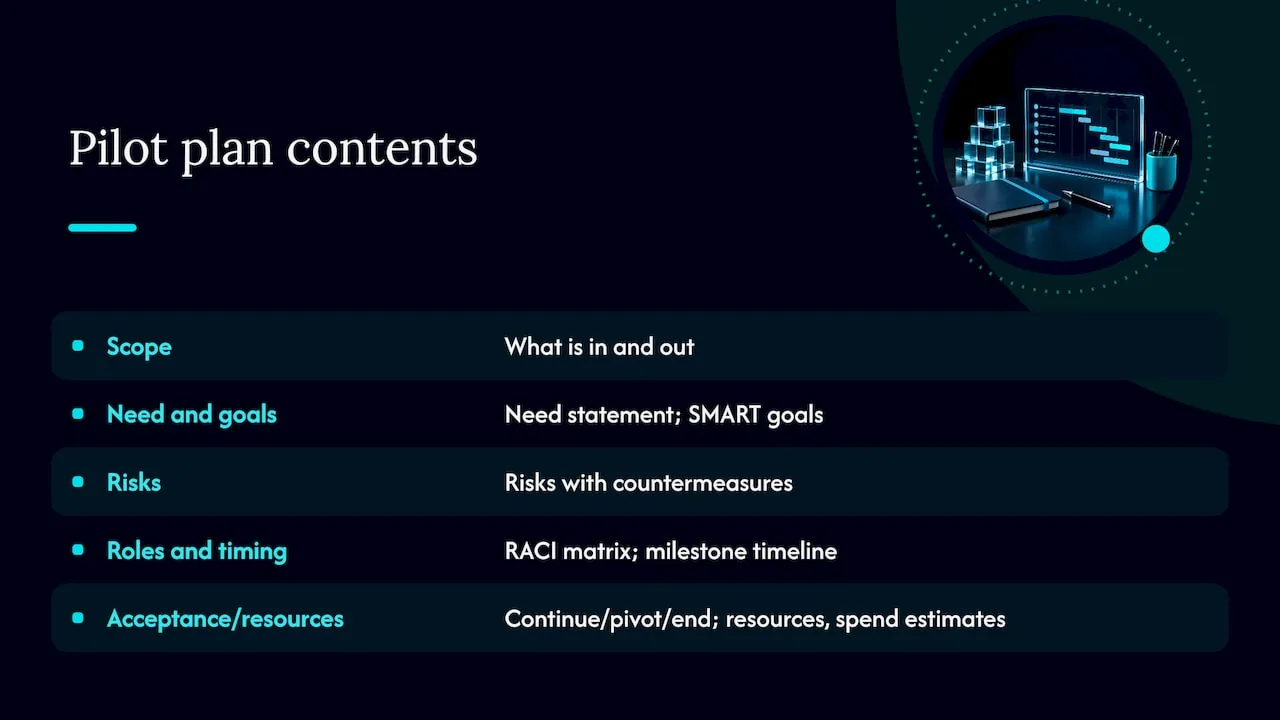
Plan templates from the public sector and from project bodies converge on the same contents. The Lyrasis pilot plan template, for example, includes scope with what is in and out, a statement of need, SMART goals, risks with countermeasures, a RACI matrix for roles, a milestone timeline, acceptance criteria with continue, pivot or end decisions at milestones, and resource and spending estimates. For a SaaS AI pilot, one to two pages is enough if each of these is specific.
1. Scope: one process, one data domain, a few users
Write down what is in and what is out. A workable default is one process, two or three teams, and one data domain such as CRM accounts or finance invoices. Name the systems the agent may read and the ones it may write to. At this stage the write list is usually short or empty.
2. Ownership: one name per decision
Three roles are enough for most pilots:
- Business sponsor: owns the outcome and approves changes to scope, budget and go-live.
- Pilot lead: runs the plan day to day and owns the document.
- Data and security owners: sign off the parts they are accountable for, including who can see which records.
This is the gap in companies where AI is in use but nobody owns it. When every team experiments separately, there is no one to choose the process, set the criteria or say stop. Our Fractional Chief AI Officer is one named person, backed by 25 years of running operations, who fills that role: deciding where AI pays and building the working system, so strategy and build do not drift apart.
3. Baseline: measure before you build
Record the current state of the process before launch, using the same method you will use afterwards. Volume, time per task, error rate and, for customer-facing work, satisfaction. Take it over a period long enough to include busy and quiet weeks.
This is not a formality. Without a baseline, you are left with user impressions, and self-reported time savings can differ from measured ones. A comparison group, even an imperfect one such as a similar team not using the agent, gives you stronger evidence than a larger number of users alone.
4. Success criteria: numbers, thresholds and a pass rule
Choose one primary metric and up to three supporting ones. For each, write the baseline, the target, the measurement window, the data source and who owns it. Examples of useful criteria:
- Median handling time for the process drops by a stated percentage against the baseline.
- Weekly active use by the pilot group holds above a stated level in the final weeks.
- Error rate on sampled outputs stays below a stated limit, with no unresolved severe errors.
- No security or compliance findings rated high.
- Cost per task stays within the business case.
We leave the numbers to you because they depend on the process. What matters is that they exist in writing before the first user logs in.
5. Timeline: one to three months live
A live phase of one to three months is typical, long enough to cover a month-end close or a renewal cycle. Add a short setup phase for the data work and a fixed-date decision meeting at the end, with the evidence pack circulated beforehand.
6. Risks, rollback and stop rules
Write the triggers that pause the pilot. Technical ones, such as an error rate above a set level. Business ones, such as customer complaints or a budget overrun. And write the rollback: how the team works if the agent is switched off tomorrow. Test that rollback before launch.
Running the pilot
Keep the routine simple.
- Production-like environment. Use real sign-in and role-based permissions. An agent should see only what the person using it is allowed to see. Our build, pilot and testing run on self-hosted European infrastructure in Germany.
- Approval and audit. Where an agent updates a record or triggers a process, the action needs an approval step where the risk calls for it, and every action needs a log entry. Our agents work within permissions, with approval where needed and an audit trail.
- One feedback channel and a weekly check-in. Sort feedback into three buckets: questions the agent could not answer, answers that were incomplete, and friction in use. Record the scenario and what the user did instead. Turn representative problems into test cases you rerun after every change.
- Sampling. Review a share of outputs every week. A federal agency pilot reported on by GovLoop shows why: a summarizer cut reading time in testing but stalled over privacy and labor concerns, and only moved forward after a 90-day transition with weekly sampling of outputs.
- Plain language for users. People should ask for data and trigger actions in ordinary words, across CRM, finance and product. If using the agent needs training in prompts, adoption will be the weak metric.
Deciding: scale, revise or stop
On the decision date, compare results to the criteria, not to impressions. There are three honest outcomes.
| Outcome | When it applies | What happens next |
|---|---|---|
| Scale | Every criterion met, and each production-readiness item has an owner and a date | Plan waves, keep the same KPIs |
| Revise | Value is clear but one criterion failed for a fixable reason | Change once, retest, set a new decision date |
| Stop | No value at the decision date, or a risk cannot be controlled at acceptable cost | Record what you learned, retire the data and access |
Stopping is a legitimate result. APM’s guidance on pilots is clear that the control structure must allow prompt cancellation. A pilot that cannot end is not a pilot.
Write the decision down with the accountable owners and next actions. A recommendation on its own does not close the pilot.
From pilot to production
The move to production is where many pilots stall, because the pilot ran on goodwill and a few engaged users. Before the first production wave, make sure each of these has an owner:
- Security review and a signed risk assessment.
- Access controls tied to your directory, including people joining, moving and leaving.
- Monitoring for quality, errors, cost and drift.
- A support route: who answers the first question, who fixes the second.
- Cost per task measured at pilot volume and projected to production volume.
- Data pipeline refresh schedules, with someone alerted when they fail.
- Training for the next group of users.
Roll out in waves, one team or region at a time. Keep the pilot KPIs, keep a comparison group in the early waves and review the business case with measured numbers after each wave. Plan a short period of close support after every wave, and a post-launch review a few months after the last one.
One point from our approach helps here: the client owns what is built. Source code, documentation and infrastructure transfer to you, on terms set in each contract, so moving to production does not mean renegotiating access to your own system.
GDPR, NIS2 and the EU AI Act in a pilot
This is general orientation, not legal advice. Have your counsel or data protection officer confirm how the rules apply to your company.
What to check in the plan:
- Personal data. GDPR governs any personal data the pilot touches. Decide which fields the agent needs, how long logs are kept, and who may see them. A pilot with real customer data needs the same lawful basis and safeguards as production.
- Role under the AI Act. The Act applies to providers who place AI systems on the EU market, to deployers established in the EU, and to non-EU parties whose system output is used in the Union. Work out whether you are a provider, a deployer or both. The consolidated Regulation (EU) 2024/1689 is the official text.
- Risk category. Check whether the use falls under the Annex III high-risk categories. The text sets out exceptions, such as narrow procedural tasks, and a provider that treats an Annex III system as not high-risk must document that assessment. High-risk systems carry transparency, human oversight and logging requirements.
- Transparency. If users or customers interact with an AI system, check the transparency duties in Article 50. Application dates for some obligations have been adjusted, so confirm the current timetable on the official EU pages.
- NIS2. If your company falls under the NIS2 Directive, the security of the systems the agent touches is part of your wider obligations. Include the security lead in the plan.
Building these in from the start costs far less than retrofitting them after a pilot has already run on production data. No design choice guarantees compliance, but a plan that names the data, the role, the risk category and the logging gives your advisers something concrete to review.
Common mistakes
- No baseline. The most frequent and the most damaging, because it cannot be repaired afterward.
- Too many use cases. Three small pilots at once teach you less than one clear one.
- Success defined after the fact. Criteria written once the results are in will always be met.
- No owner on the business side. The pilot becomes an IT project nobody uses.
- Pilot data that does not match production. Cleaned samples hide the cases that break the agent later.
- No stop rule. The pilot runs on for a year with no decision.
Our perspective
We see the same pattern in SaaS companies of 20 to 200 people. Several teams use AI tools, each for a different task, and nobody is accountable for whether any of it pays. Pilots then start from enthusiasm, not from a measured cost.
Our view is that a pilot is the second step, not the first. The first is deciding where AI pays, which means finding the most expensive process and putting a number on it. The second is making the CRM and finance data something an agent can read without guessing. Only then does a pilot tell you anything about the agent itself.
That is why we work in the order data foundation, AI layer, department agents, and why one person should own both the strategy and the build. When the person who decides where AI pays is also the person who builds the working system, the pilot criteria and the system stay aligned.
We also say plainly where AI does not belong: decisions about people, unsupervised changes to financial records, and processes nobody can define. A pilot that respects those limits is easier to approve, easier to audit and easier to scale.
Claus Nielsen
How NordOps Consulting can help
If you want a pilot candidate chosen on evidence, the AI Readiness Assessment is where we start, from €4,500. An AI Snapshot is a lighter first look at €2,500 to €3,500. For ongoing ownership, the Fractional Chief AI Officer retainer starts from €1,500 a month (Advisor), from €3,250 (Operating) and from €5,500 (Embedded).
Builds are priced in one of two ways: 30% of the first-year saving, once measured and proven, or a fixed price for a capability agreed before work starts. You can also book a free 30-minute discovery call to talk through your first pilot. See our AI agents for Finance, Sales and Customer Success and our AI adoption method for how this works in practice, or where to start with AI in operations if you are still choosing a process.
FAQ
How long should an AI pilot run?
A live phase of one to three months suits most SaaS processes, as long as it covers both busy and quiet periods. Add a short setup phase for baseline and data work. Fix the decision date at the start so the pilot cannot drift.
What is the difference between a pilot and a proof of concept?
A proof of concept tests whether something can work technically, usually on sample data. A pilot tests whether it delivers value with real users and real data, against criteria written beforehand. If you already know the technical side works, go straight to a pilot.
Who should own the pilot?
A business leader should own the outcome, for example the head of Finance, Sales or Customer Success. A pilot lead runs the plan, and data and security owners sign their parts. If no one in the company holds AI as a responsibility, a Fractional Chief AI Officer can take that role.
Does a pilot need to comply with GDPR and the EU AI Act?
Yes, to the extent the pilot uses personal data or falls within the AI Act’s scope. A pilot on real customer data needs the same data protection thinking as production. Confirm your specific position with your counsel or data protection officer.
What if the pilot fails?
Stopping is a valid result. Record what you learned, retire the data and access, and decide whether a different process or a data fix should come next. You have spent a small amount to avoid a large one.
Sources
- APM: What is the difference between a trial and a pilot?
- PMI: Pilot projects, making innovations and new concepts fly
- Lyrasis: Pilot Project Plan Template
- EU Regulation 2024/1689, consolidated text
- GovLoop: From AI Pilots to Outcomes