Sovereign AI in Europe means keeping control over the data, infrastructure, models and operations behind your AI, under rules you can enforce. For a B2B SaaS company with 20 to 200 people, this is rarely about building a national model. It is about knowing where your customer and finance data sits, who can reach it, which AI tools read it, and who in your company answers for all of that.
The term is used loosely. Governments, cloud vendors and analysts each mean something different by it. This guide separates the policy meaning from the practical one, and shows what a growth-stage SaaS leader can control this year.
TL;DR
- In Europe, “sovereign AI” covers data location, legal jurisdiction, infrastructure, and who operates the system. Hosting in an EU region addresses only part of that.
- GDPR and the EU AI Act are legal duties. Sovereignty is a design goal that helps you meet them, and it does not replace them or guarantee compliance.
- For a SaaS company, the useful questions are about your own data, your providers, your permissions and your AI governance, not about building models.
- Start with the data foundation (CRM and finance as the source of truth), then the AI layer, then department agents. Some work does not belong with AI at all.
- Name one owner for AI. Without one, sovereignty stays a slide in a deck.
Table of Contents
- What sovereign AI means in the European context
- Why Europe is pursuing it
- Sovereign AI is not the same as GDPR, the EU AI Act or EU hosting
- What makes up a sovereign AI stack
- What a SaaS company should actually assess
- The order matters: data foundation, AI layer, department agents
- Where AI does not belong
- How to evaluate a “sovereign” claim from a vendor
- What it costs to start
- Start with an owner for AI
- FAQ
- Sources
What sovereign AI means in the European context
There is no single legal definition that every source shares. Researchers describe the idea from different angles, and the differences matter.
Sciences Po researchers frame AI technological sovereignty as the ability to mobilize and integrate AI-related competencies locally. That is a skills and capacity view: it asks whether Europe has the people, tools and know-how to run AI without depending on others.
Daniel Mügge, writing in the Journal of European Public Policy, argues that EU AI sovereignty discourse is mainly jurisdictional and competitive. In his reading, it is about economic standing in a global race and about whose rules apply, more than about individual empowerment.
A third view comes from a European University Institute brief published in November 2025. It warns that sovereignty narratives can be used for “sovereignty washing”, and says policymakers should state the specific goal behind any sovereignty claim.
For a company buyer, that last point is the practical one. When a vendor says “sovereign,” ask: sovereign from what, and for whom?
Why Europe is pursuing it
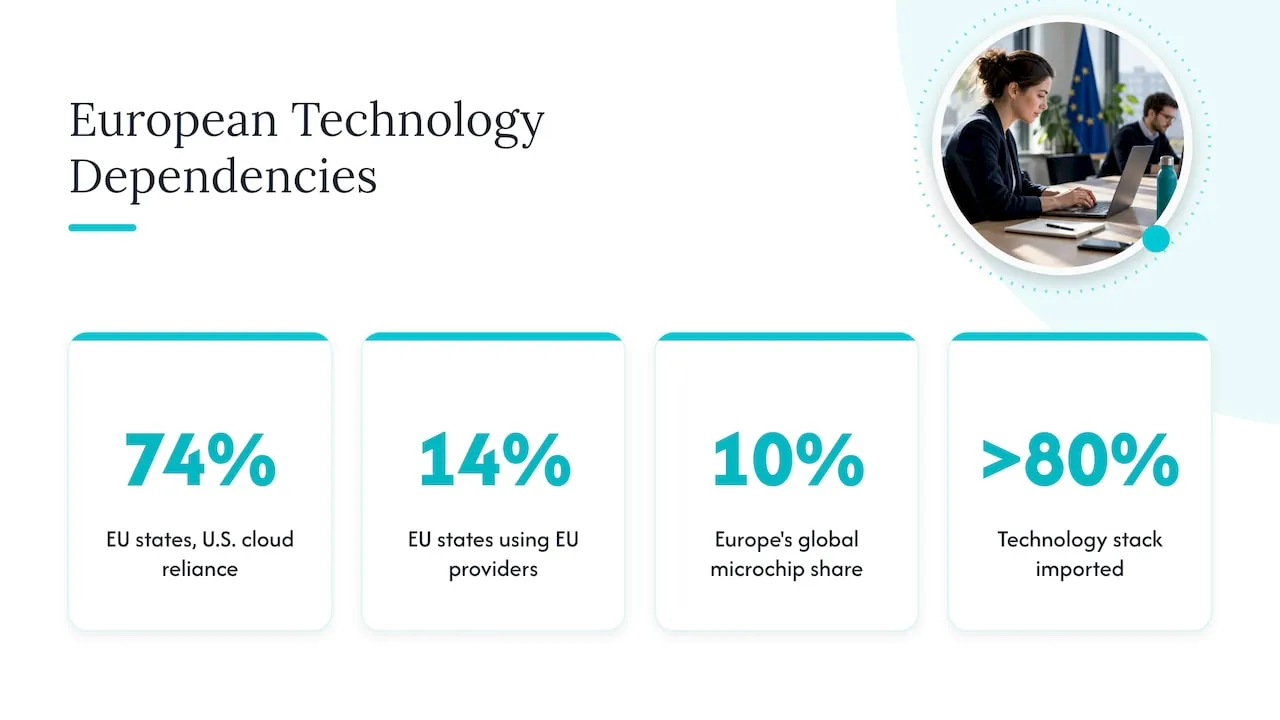
The driver is dependency. Brookings reports that as of September 2025, 74 percent of EU member states partially rely on U.S. cloud providers, while only 14 percent use EU providers. The same analysis puts Europe at 10 percent of the global microchip market, with more than 80 percent of its technology stack imported.
The European Commission is responding with policy. The Cloud and AI Development Act is part of the AI Continent Action Plan and aims to triple EU data centre capacity within 5 to 7 years, while simplifying permitting. The Apply AI Strategy adds a buy-European approach, particularly for the public sector, with a focus on open-source AI. The Apply AI Alliance serves as the main forum bringing together providers, industry, academia and the public sector.
Most of this targets governments and infrastructure providers. As a SaaS buyer, you will feel it in three ways: more European options for hosting and compute, more questions from your own enterprise customers about where their data goes, and clearer expectations about what “sovereign” has to mean.
Sovereign AI is not the same as GDPR, the EU AI Act or EU hosting
These four ideas get mixed up in sales decks. Here is a plain way to separate them. This is general information, not legal advice.
| Concept | What it is | What it does not cover |
|---|---|---|
| GDPR | Law on processing personal data | Does not decide which AI tools you pick or who owns the system |
| EU AI Act | Risk-based law on AI systems | Does not address your cloud dependency or vendor lock-in |
| NIS2 | EU directive on cybersecurity and risk management for in-scope entities | Does not set AI policy by itself |
| EU hosting | Servers physically in Europe | Does not settle who controls the provider, the keys or the operations |
| Sovereign AI | Control over data, infrastructure, models and operations | Not a legal status you can claim by buying one product |
The EU AI Act is Regulation (EU) 2024/1689. It establishes risk-based rules for AI systems, including transparency duties for general-purpose AI (GPAI) models, and GPAI model obligations have applied since August 2, 2025. As of August 2, 2026, the European AI Office has enforcement powers over GPAI models, including requesting documentation and issuing fines. Those duties fall mainly on model providers. As a SaaS company that deploys AI, your obligations depend on how you use it, so read the Act’s provisions on AI literacy and transparency. We cover them in our guide to EU AI Act Articles 4 and 50 for SaaS.
The key point: no tool, region or certificate guarantees compliance. Sovereignty makes compliance easier to demonstrate because you know where things are and who is responsible.
What makes up a sovereign AI stack
The Commission’s own framing helps here. The Cloud and AI Development Act describes sovereignty through four assurance levels based on data location, independence from third countries, and software supply chain transparency. Even if you never buy for the public sector, those three dimensions are a good checklist for any provider.
In practice, a stack has five layers, and each can be more or less sovereign:
- Data. Where it is stored, who can read it, who holds encryption keys.
- Compute and hosting. Which legal entity runs the servers, and under which country’s law.
- Models. Whether you call a hosted model through an API, run an open model yourself, or use a mix.
- Integration. How the AI reaches your CRM, finance and product systems, and with what permissions.
- Operations. Who monitors it, approves actions, logs them, and shuts it off.
Open-source models help with the third layer, but not automatically. The EU’s Interoperable Europe portal notes that open-source AI can support public administrations’ technological sovereignty only if they keep control of the AI system, its data and the infrastructure it runs on. The same logic applies to a company: an open model on someone else’s infrastructure, with someone else’s keys, is not under your control.
What a SaaS company should actually assess
You do not need a national compute cluster. You need honest answers to a short list of questions. Work through them with your CTO, your data protection contact and whoever runs operations.
Data control
- Which systems hold customer, contract and revenue data, and which of them is the agreed source of truth?
- Which AI tools can read that data today? Include the ones individual employees signed up for themselves.
- Does any personal data leave your environment when someone pastes it into an assistant?
- Can you delete or export what the AI has processed?
Providers
- Which legal entity runs each AI service, and where is it headquartered?
- Is the model provider using your inputs for training? Is that in the contract?
- What happens if the provider changes terms, prices or availability? How fast could you move?
Permissions
- Does the AI see only what the person asking is allowed to see?
- Can an agent change records, trigger processes or provision access? If so, which actions need human approval?
- Is every action logged in a way you can audit later?
Governance
- Is there one named person who decides where AI is used and where it is not?
- Do staff who use AI have the training the EU AI Act’s AI literacy provision expects?
- Do you have a written inventory of AI uses, with a risk view per use?
If you cannot answer half of these today, that is normal for a company where AI grew from the bottom up. It is also the signal that the problem is ownership rather than technology. Our AI governance framework for B2B SaaS companies turns these questions into a working structure.
The order matters: data foundation, AI layer, department agents
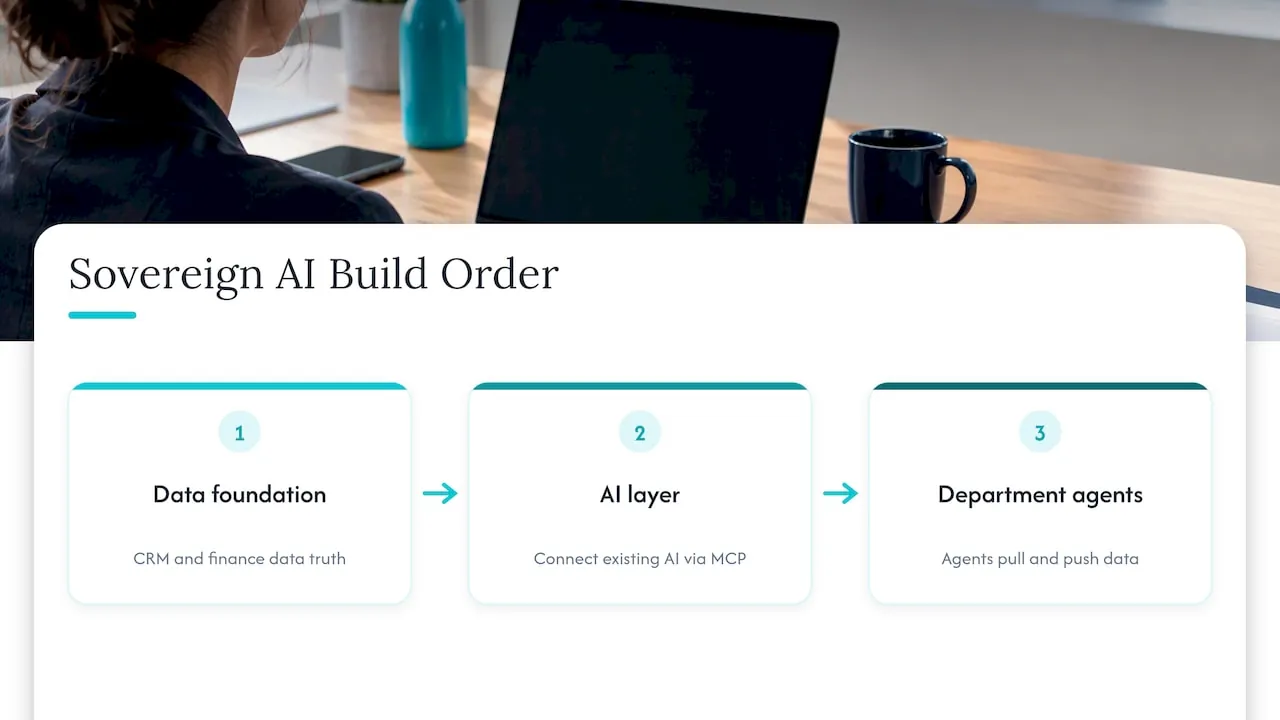
Most sovereignty failures in SaaS companies are not infrastructure failures. They happen because AI is connected to messy, duplicated data before anyone decides what is true. We build in a fixed order.
1. The data foundation. Your CRM and finance data become the source of truth. A processing layer turns data from the systems around them into one agreed version. If sales says one number and finance says another, an AI assistant will repeat both with confidence.
2. The AI layer. The data is connected to the AI assistant your company already uses, through MCP (Model Context Protocol), within the permissions you set. You keep the assistant people know, and you decide what it can read and do.
3. Department agents. Purpose-built agents for Finance, Sales and Customer Success, used in plain language. They pull data (ask, report, look up across CRM, finance and product) and push data (update records, trigger processes, provision access). Approval steps and an audit trail sit around the actions that matter. See our AI agents for Finance, Sales and CS for how this looks by department, and the Admin Portal for the control surface.
We design for GDPR, NIS2 and the EU AI Act from the start, and we run build, pilot and testing on self-hosted European infrastructure in Germany. That is a design choice that supports your own compliance work. It is not a certificate, and your legal counsel still decides what your obligations are.
Where AI does not belong
Sovereignty also means deciding where AI should not run. We are explicit about this with every client.
- Decisions with legal or major personal consequences for a person (hiring, firing, credit-like judgments) without a human decision-maker and a documented basis. The EU AI Act treats some of these uses as high-risk, so get proper legal review first.
- Processes nobody has written down. If the team cannot describe the steps, automating them fixes the confusion in place.
- Data nobody trusts. An agent on top of two conflicting customer lists just produces faster disagreement.
- Low-volume, low-cost tasks. If a task takes twenty minutes a month, the build and the oversight cost more than the saving.
- Anything where an error cannot be reversed and nobody reviews it. Payments, contract terms and access rights need an approval step.
- Sensitive personal data in tools you have not assessed. Until a tool is reviewed, keep it out.
The rule we use: adopt AI one process at a time, starting with the most expensive one. Start where the cost is measurable and the data is clean enough to trust.
Our view: ownership beats origin
Most conversations about sovereign AI start with where the servers are. We start with who is responsible. In the growth-stage SaaS companies we meet, AI is already in use, in sales notes, support replies and finance spreadsheets, but nobody owns it. That is the real sovereignty gap: nobody can say what the AI reads, what it may change, and who approved that.
After 25 years of running operations, our conclusion is that strategy and the working system must come from the same person, or they drift apart. That is why NordOps Consulting provides a Fractional Chief AI Officer who decides where AI pays and also builds it. The data foundation comes first, because agents are only as trustworthy as the data they read.
We also think you should own what is built. Source code, documentation and infrastructure transfer to you at handover, so your AI does not depend on our continued presence. For us, that is what sovereignty looks like at company scale: control you can actually exercise.
Claus Nielsen
How to evaluate a “sovereign” claim from a vendor
Because the term is easy to abuse, test every claim with these questions.
- Who is the contracting and operating entity? An EU data center run by a non-EU parent can still raise jurisdiction questions. Ask your counsel what that means for you.
- Who holds the keys? Encryption you cannot control limits what sovereignty means in practice.
- Can you leave? Ask for data export formats, model portability and what happens at contract end.
- What is logged? You need an audit trail of what the AI read and did, in a form you can review.
- Which assurance claim is it? Compare the vendor’s wording with the Commission’s dimensions: data location, independence from third countries, supply chain transparency. Vague words like “fully sovereign” with no evidence deserve the EUI’s warning about sovereignty washing.
- Does it fit your size? A 60-person SaaS company rarely needs sovereign compute. It needs clear data boundaries and a provider it can replace.
What it costs to start
You do not have to commit to a build to get clarity. Our entry points, as published on our site:
- AI Snapshot: 2500-3500 EUR, one-off.
- AI Readiness Assessment: from €4,500, one-off. It reviews where AI is used, what data it touches and where the largest savings sit. See the AI Readiness Assessment.
- Fractional Chief AI Officer: from €1,500 per month (Advisor), from €3,250 per month (Operating) and from €5,500 per month (Embedded).
- Builds: 30% of the first-year saving, once measured and proven, or a fixed price agreed before work starts.
The first call is a free 30-minute discovery call.
Start with an owner for AI
If your team uses AI and nobody can say who owns it, the first step is not a new platform. It is a named person, a clear map of your data, and one process chosen for the first project. Our Fractional Chief AI Officer service provides that person, starting from €1,500 per month, with the build done on European infrastructure and handed over to you.
If you would rather see where you stand first, book the free 30-minute discovery call through NordOps Consulting and bring your list of AI tools. We will tell you honestly whether an assessment makes sense, and where AI should stay out.
FAQ
Is sovereign AI the same as hosting AI in an EU data center?
No. Location is one dimension. The Commission’s approach to cloud and AI sovereignty also looks at independence from third countries and software supply chain transparency. A European region run by a non-European provider answers the first question only partly. Ask your counsel how jurisdiction applies to your situation.
Does using sovereign AI make us compliant with the EU AI Act or GDPR?
No. Nothing guarantees compliance. GDPR and the EU AI Act set duties for how you use data and AI, and those depend on your actual use cases. Sovereign design makes it easier to know where data is, who has access and what was logged, which supports your compliance work.
Does a 50-person SaaS company need its own models or GPUs?
Usually not. Most companies of that size get more value from a clean data foundation, clear permissions and a provider they can replace. Self-hosted models make sense only where data sensitivity or cost justifies the operating effort.
Who should own sovereign AI inside a SaaS company?
One named person with authority across Finance, Sales, Customer Success and engineering. In smaller companies, that is often a COO or a fractional Chief AI Officer. The role decides where AI is used, where it is not, and what each agent may read and change.
Sources
- EU AI sovereignty: for whom, to what end, and to whose benefit? (Journal of European Public Policy)
- European Sovereignty in Artificial Intelligence: A Competence-Based Perspective (Sciences Po)
- Unpacking AI sovereignty (Publications Office of the EU)
- Making the case for a third AI technology stack (Brookings)
- Cloud and AI Development Act (European Commission)
- Apply AI Strategy (European Commission)
- AI Act (European Commission)
- Rules for trustworthy artificial intelligence in the EU (EUR-Lex)
- Open Source AI (Interoperable Europe Portal)