Revenue operations AI works when it reads one agreed version of your CRM and finance data, takes over repetitive tasks such as record updates, follow-ups and reporting, and leaves consequential decisions to people. It fails when it sits on top of inconsistent data, with no owner and no approval path. This guide covers where AI pays in RevOps, what data it needs first, where it does not belong, and what European SaaS companies should keep in mind under GDPR and the EU AI Act.
TL;DR
- RevOps aligns marketing, sales, customer success and finance around one revenue journey. AI is most useful when it works across those functions, not inside one team’s silo.
- Fix the data first. Agents that read inconsistent CRM and finance records produce unreliable results, however good the model is.
- Start with one expensive, repetitive process: CRM updates, follow-ups, reporting or deal inspection. Measure it, then expand.
- Keep people in control of high-impact actions. Use permissions, approval steps and an audit trail.
- In Europe, assess GDPR and the EU AI Act for every use case. Neither one replaces the other.
Table of Contents
- What revenue operations does, and where AI comes in
- Which RevOps tasks AI can handle
- What results to expect
- The data foundation comes first
- Where AI does not belong in RevOps
- Keeping people in control
- Choosing the first use case
- GDPR and the EU AI Act in revenue operations
- Our perspective
- How NordOps Consulting can help
- FAQ
- Sources
What revenue operations does, and where AI comes in
Revenue operations coordinates marketing, sales, customer success and finance across the whole revenue journey, from product development and pricing through sales, support and cash collection. Salesforce’s RevOps guide describes the goal as aligning processes, technology and revenue goals so the departments stop working from separate pictures of the customer.
In a SaaS company of 20 to 200 people, that usually means a small group, sometimes one person, who owns the CRM, the reporting, the handoffs between sales and customer success, and the link to billing. It is operational work, and a lot of it is repetitive.
AI has been part of RevOps for years in predictive form. BCG’s 2025 research on RevOps notes that predictive AI has traditionally supported customer segmentation, churn forecasting and sales optimization. Generative and agentic AI extend that from predicting toward executing: drafting, updating, routing and triggering.
That shift is why the topic matters now. A prediction is something a person reads. An action changes a record, sends a message or grants access. The second needs much more care.
Which RevOps tasks AI can handle
The research points to a fairly consistent list. BCG reports that agentic AI can schedule follow-ups, track deals, update CRM records, manage and nurture leads, and handle early-stage customer interactions. It also lists personalized outreach, sales coaching, pipeline and deal inspection, RFP and contract workflows, and account and territory planning.
IBM’s guide adds lead routing, account assignment, lead scoring, CRM extraction from emails and calls, forecasting, churn-risk detection and billing or collections assistance.
Sorted by what a SaaS leader actually feels day to day, the tasks fall into four groups.
Pulling data: ask, report, look up
The most immediate gain is letting people ask a question in plain language and get an answer drawn from CRM, finance and product data. A head of Sales asks which renewals this quarter have open support escalations. A CFO asks how much of the pipeline sits with accounts that are overdue on invoices. Without AI, each question is a request to RevOps, a spreadsheet and a day of waiting.
Pushing data: updates and triggers
The second group is writing back: logging call notes into the right fields, updating a stage after a signed order form, provisioning access when a customer onboards. This saves the most hours and carries the most risk, which is why it needs the controls described below.
Inspection and forecasting
AI can flag stalled deals, missing contacts, and gaps between the forecast and the underlying activity. It reads far more records than a person can. It does not replace the judgment of the leader who owns the number.
Routing and administration
Lead routing, account assignment and follow-up reminders are rule-heavy and repetitive. They suit automation, provided the rules are written down first.
What results to expect
Be realistic about the size of the gains. BCG’s October 2026 survey of sales leaders found that 33% saw a reduced administrative workload and 18% saw better forecast accuracy. Only 13% reported a measurable improvement in win rate and 14% in conversion.
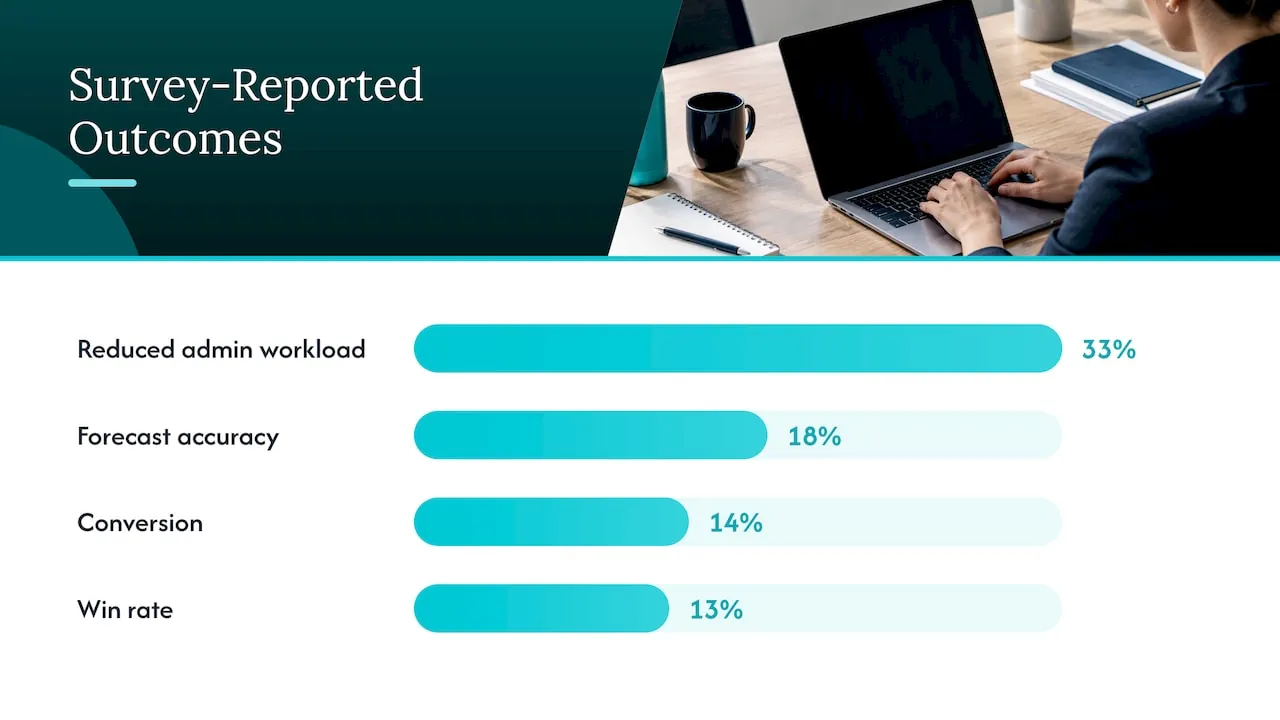
The pattern is clear. AI reliably removes administrative load. Gains in revenue outcomes are harder to show and come later. A sensible business case for the first project is therefore built on hours saved, errors avoided and faster reporting, not on a promised jump in win rate.
BCG also reports that some companies have cut RFP turnaround times by up to 20%, a useful reference for document-heavy workflows, though your own result depends on your process and your data.
The data foundation comes first
Most stalled RevOps AI projects share one cause: the agent is pointed at data nobody agreed on. IBM’s guide says RevOps needs clean, structured and trustworthy data, clear data ownership and security policies, and standardized workflows. Without them, agents may produce unreliable results. It adds that an agent’s value depends on its permissions and on a unified, current view of the customer and revenue.
In practice, a SaaS company of this size has the customer spread across a CRM, a billing system, a support tool, product analytics and a handful of spreadsheets. Each holds a slightly different version. Ask an AI assistant “what is this customer worth?” and it will answer confidently from whichever version it can reach.
The order that works:
- Decide the source of truth. For most SaaS companies the CRM holds the commercial record and the finance system holds the money. Agree which field wins when they disagree.
- Clean and connect the data. Standardize stages, owners, amounts, close dates and renewal dates. Remove duplicates. Connect the systems around the CRM so changes flow one way, by rule.
- Document the processes. If nobody can write down how a lead becomes a customer and then a renewal, an agent cannot follow it.
- Then connect the AI. Only now does an AI assistant read the data and act on it.
This is the order we follow at NordOps Consulting: the data foundation, then the AI layer that connects that data to the assistant your team already uses, then department agents for Finance, Sales and Customer Success. Our Processor is the part that turns the data into one agreed version of the truth.
Where AI does not belong in RevOps
Being clear about limits protects the projects that should go ahead. AI is the wrong tool in these cases:
- Decisions that need accountability. Pricing exceptions, discount approvals, territory changes and compensation disputes need a named person who decides and can explain why.
- Fields that drive other decisions. DailyRevOps suggests that owner, territory, stage, forecast, amount, close date, renewal date, health and churn risk should not change from a model’s suggestion alone. We agree: a human should confirm these.
- Processes nobody has defined. Automating a messy handoff produces a faster mess. Fix the process, then automate it.
- Low-volume work. If a task happens twice a month and takes ten minutes, the build and the oversight cost more than the saving.
- Data you cannot trust yet. An agent that acts on wrong records spreads the error across systems faster than any person could.
- Sensitive personal data without a clear purpose. Under GDPR, having the data is not a reason to feed it to a model.
The test we use is simple: if the action is expensive to reverse, a person approves it.
Keeping people in control
Trust is the main adoption issue. Teams worry that an agent will update the wrong record or break an ownership rule. The answer is design, not reassurance.
Guidance on running AI agents in RevOps converges on a few controls: document what each agent may do, who can change its rules and who approves high-impact decisions. Let low-risk recommendations move quickly, and require approval for critical actions such as deal updates, deletions and policy changes. Use role-based access and an audit trail, and monitor performance. IBM’s guide also recommends a gradual rollout with measurable criteria such as cycle time and error rate, plus user feedback.
A workable pattern for the first agent:
- Shadow mode. The agent proposes updates but changes nothing. Compare its proposals with what people actually did.
- Approval mode. The agent prepares the change, and a named person approves it with one click.
- Limited autonomy. Only low-risk, reversible, tested actions run without approval, and every one is logged.
- Monthly review. Check accuracy, override rate and exceptions before widening the scope.
Permissions matter as much as approvals. An agent used by a sales rep should see what that rep may see, and nothing more.
Choosing the first use case
Do not start with a tool. Start with the most expensive process. BCG recommends prioritizing use cases that deliver visible impact quickly, and names sales content, forecasting and deal execution as good starting points. It also advises standardizing processes, adopting a unified platform strategy, and testing with real-world feedback.
To pick yours, score each candidate process on four questions:
| Question | Good sign | Warning sign |
|---|---|---|
| How many hours does it take each month? | Dozens, across several people | A few hours, one person |
| Is the process written down? | Clear steps and owners | Different every time |
| Is the data reliable? | One agreed source | Conflicting records |
| What happens if it is wrong? | Easy to reverse | Customer or revenue impact |
The best first candidates are processes high on hours, documented and reversible. Month-end reporting that pulls from CRM and finance, renewal preparation, and CRM hygiene after calls are common examples in SaaS companies.
Measure before you build. Record the current hours, error rate and cycle time, so a saving can be shown afterward and not just claimed. A pilot that runs for a defined period with agreed metrics is easier to judge, and easier to stop, than an open-ended rollout.
GDPR and the EU AI Act in revenue operations
RevOps is full of personal data: contacts, emails, call recordings, usage by named users. Two frameworks apply, and neither replaces the other. This is general information, not legal advice, so involve your data protection officer or counsel for specific decisions.
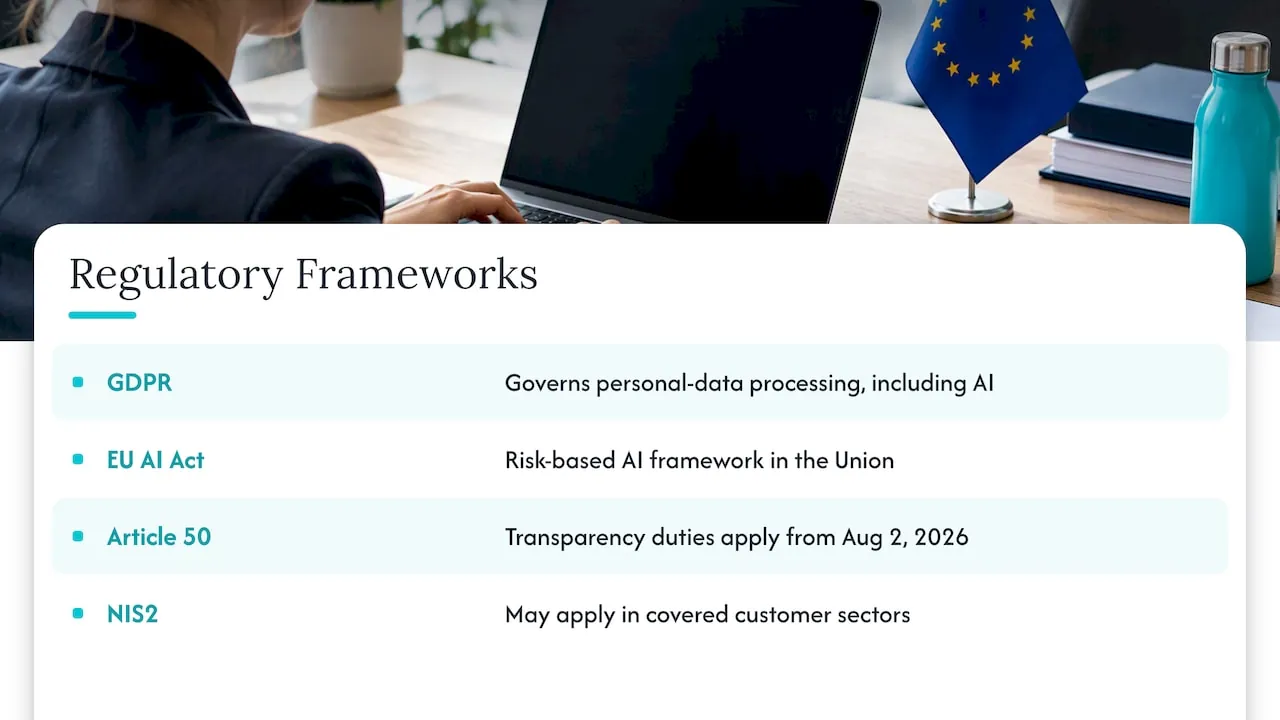
GDPR continues to govern any processing of personal data, including when an AI system does it. In general terms, that means a lawful purpose, collecting only what you need, keeping data accurate, running a data protection impact assessment where required, and having safeguards around decisions made by automated means.
The EU AI Act, Regulation (EU) 2024/1689, sets a uniform, risk-based framework for developing and using AI systems in the Union. For RevOps, one duty is practical. The Article 50 transparency obligations apply from August 2, 2026, including informing people when they are communicating with an AI system and marking certain AI-generated content. If an agent handles early-stage customer conversations or generates outbound content, check how those duties apply to you.
The same guidance index notes that meeting the AI Act does not displace GDPR: a practice outside an AI Act prohibition can still be unlawful under data protection law. Treat the two as separate checks for every use case.
NIS2, the EU’s network and information security directive, may also matter if you serve customers in sectors it covers, since it raises expectations on security and supplier risk. Check whether it applies to you or your customers.
No tool, architecture or hosting choice guarantees compliance. What a design can do is make the checks easier: permissions, logs, approval records and a clear record of what each agent may do. We build with GDPR, NIS2 and the EU AI Act as design requirements from the start, and we run build, pilot and testing on self-hosted infrastructure in Germany.
Our perspective
Most SaaS companies we speak with are already using AI. Someone on the sales team has an assistant, finance is trying a tool, and customer success is experimenting. What is missing is an owner. Nobody decides where AI pays, nobody is accountable for the data it reads, and nobody can say what it did last Tuesday.
That is why we think RevOps AI starts with ownership, not software. A Fractional Chief AI Officer gives you one named person who decides which process to automate first, makes sure the CRM and finance data are the source of truth, and builds the agents your team then uses in plain language. When the same person owns the strategy and the build, the plan and the working system do not drift apart.
We also think restraint is part of the job. We would rather tell you that a process should stay manual than build an agent that saves four hours a month. Adopt AI one process at a time, starting with the most expensive one, and keep a person in the loop wherever an action is hard to undo.
And you should own what is built. Source code, documentation and infrastructure transfer to you at handover.
Claus Nielsen
How NordOps Consulting can help
If you want to know where AI would pay in your revenue operations before committing to a build, the AI Readiness Assessment is the place to start, from €4,500 one-off. It looks at your data, your processes and your regulatory position, and gives you a prioritized view of where to begin. A shorter AI Snapshot is also available, at €2,500 to €3,500 one-off.
If AI is already in use and needs an owner, our Fractional Chief AI Officer retainer runs from €1,500 per month at the Advisor level, from €3,250 at Operating and from €5,500 at Embedded. Builds are priced either at 30% of the first-year saving, once measured and proven, or at a fixed price agreed before work starts. You can see how the department agents work on our AI agents page and read about our adoption method. Or book a free 30-minute discovery call to talk through your situation.
FAQ
What do revenue operations teams do?
They coordinate marketing, sales, customer success and finance across the revenue journey so processes, systems and goals line up. In practice that means owning the CRM, reporting, handoffs between teams and the connection to billing. Salesforce’s guide describes the scope from pricing through to cash collection.
Which RevOps tasks suit AI best?
Repetitive, rule-based work with reliable data: CRM updates, follow-ups, lead routing, reporting, deal inspection and renewal preparation. Start with the process that costs the most hours and is easy to reverse if the agent gets it wrong.
Do we need clean data before using AI in RevOps?
Yes. Agents read what the systems hold, so conflicting records produce conflicting answers. Agree the source of truth, standardize key fields and document the process first. Then connect the AI.
Does the EU AI Act apply to our RevOps agents?
Possibly, depending on what the agent does. Transparency duties under Article 50 apply from August 2, 2026 to certain AI interactions and generated content, and GDPR applies in parallel to any personal data. Check each use case with your counsel or data protection officer.
Can AI replace a RevOps team?
Not in the way the question suggests. AI takes over administrative work and speeds up reporting, but someone still has to own the process design, the data, the rules the agents follow and the decisions with revenue impact.
Sources
- Salesforce: What Is Revenue Operations (RevOps)? A Complete Guide
- BCG: AI Was Made for RevOps: From Prediction to Execution
- BCG: How CROs Are Turning AI Into Sales Growth in 2026
- IBM: AI Agents and RevOps
- DailyRevOps: How to run AI-assisted CRM workflows with human checks
- European Commission: EU AI Act, Regulation (EU) 2024/1689
- Guidance and official sources for the EU AI Act