A chief AI officer (CAIO) is the senior executive who owns a company’s AI agenda: where AI is used, which projects get funded, how data and risk are governed, and whether the result shows up in the numbers. In a growing B2B SaaS company, the role matters most when people already use AI every day and nobody is accountable for it. Whether that person is a full-time hire or a fractional leader depends on how much AI work you have, not on how much you want the title.
This guide covers what the role does, what a job description should include, how it differs from an AI consultant, and how to choose between full-time and fractional.
TL;DR
- A CAIO owns AI strategy, governance, risk, and delivery, and reports to the CEO. It is an accountability role, not a research or model-building role.
- Most organizations with an AI leader do not use the CAIO title, so look at the responsibilities, not the label.
- A full-time CAIO fits when you have many AI workloads in production and enough work to fill a week, every week. Before that, fractional leadership usually fits better.
- A good job description names decision rights, a measurable business case, and EU rules (GDPR, NIS2, EU AI Act) where they apply.
- AI does not belong in every process. A CAIO’s first job is to say where it pays and where it does not.
Table of Contents
- What a chief AI officer is
- What a chief AI officer does in a B2B SaaS company
- A chief AI officer job description
- What a CAIO must know about GDPR, NIS2, and the EU AI Act
- Where AI does not belong
- Full-time or fractional: how to choose
- How a CAIO differs from an AI consultant
- Our perspective
- How NordOps Consulting works with SaaS companies
- Questions to ask before you hire one
- FAQ
- Sources
What a chief AI officer is
The Japan AI Safety Institute’s 2026 guidebook describes the CAIO as an accountable C-suite executive with cross-functional oversight of AI strategy, governance, risk management, talent development, and procurement, reporting directly to the CEO. That is a useful definition because it is about accountability. It says nothing about training models.
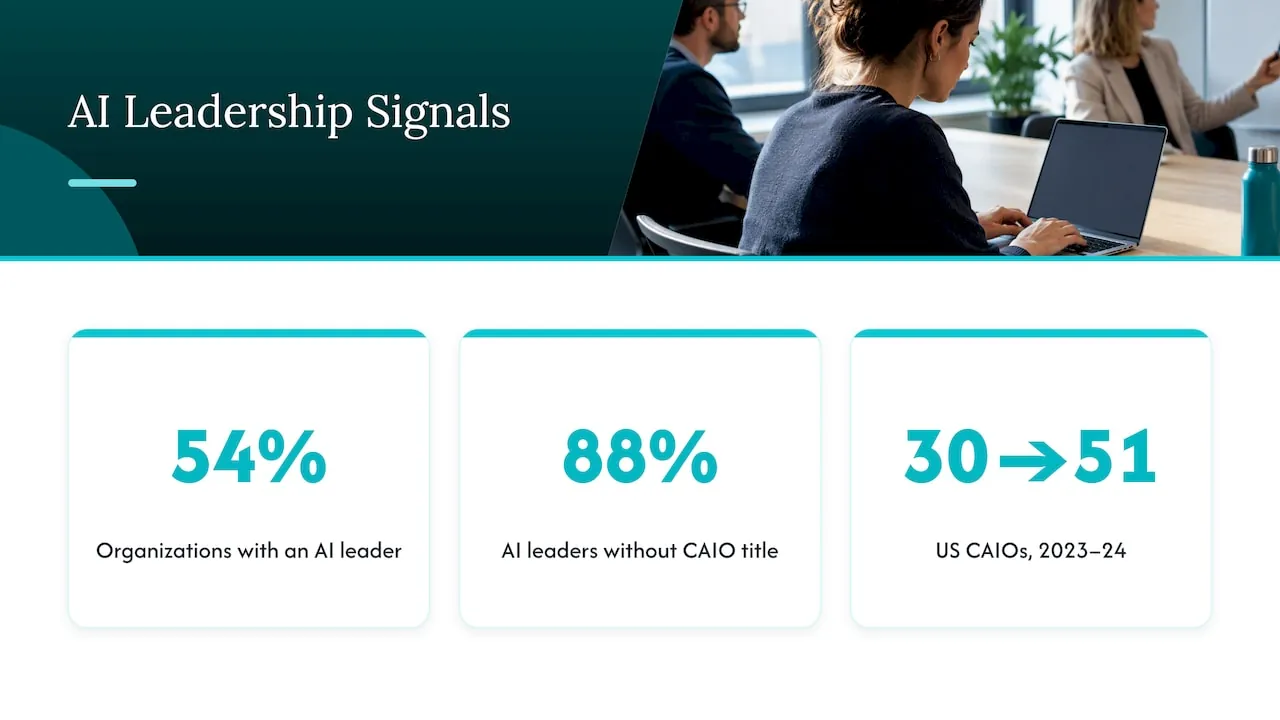
Is it an established role? It is still forming. A June 2024 Gartner poll of more than 1,800 executives found that 54% of organizations had an AI leader, but 88% of those did not hold the title of Chief AI Officer. In the United States, Altrata research counted CAIOs growing from 30 in 2023 to 51 in 2024 across 35,000 public and private companies. The numbers are small against the total, but the pattern is clear: AI leadership exists in many companies, often under another title such as CTO, head of data, or COO.
For a 20 to 200 person SaaS company, the title matters less than one question: can you name the one person who decides what AI does in your company, and who answers when it goes wrong? If you cannot, you have the problem the role exists to solve.
What a chief AI officer does in a B2B SaaS company
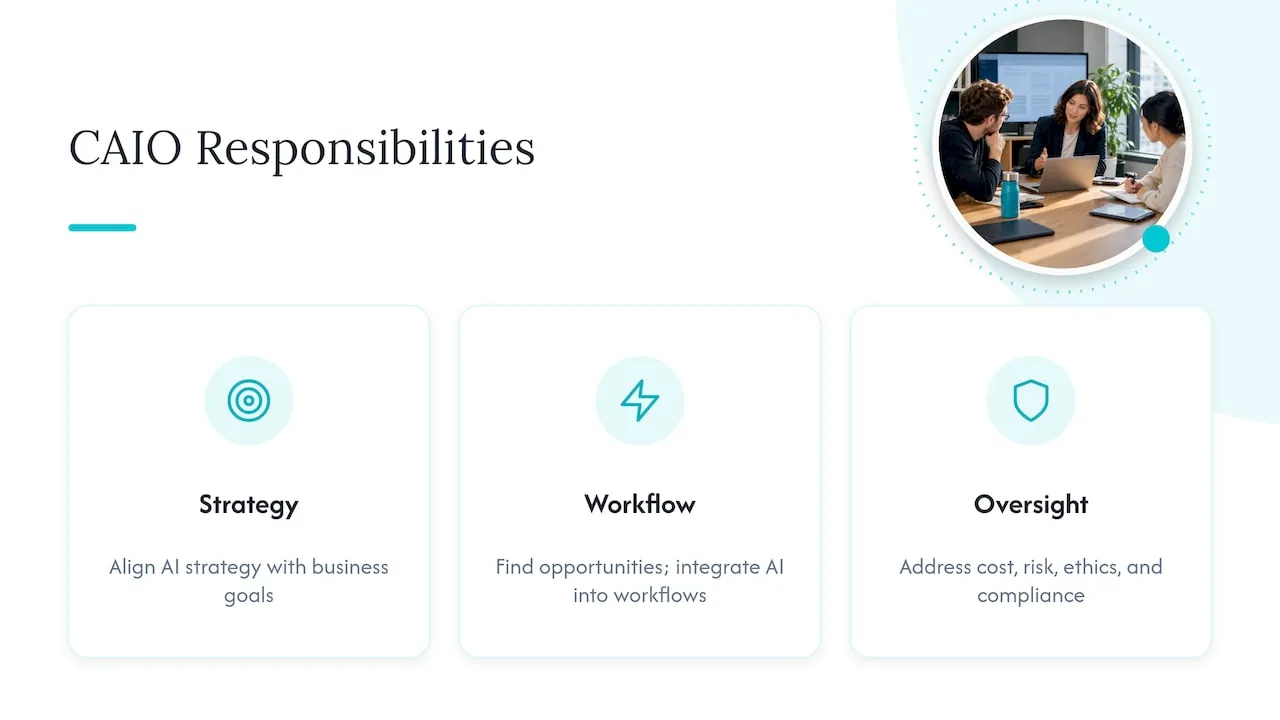
Descriptions from large firms agree on the core. TechTarget describes the CAIO’s task as building an AI strategy aligned with business goals, finding high-value opportunities, and integrating AI into workflows. PwC says the role oversees AI strategy across the enterprise and keeps AI-enabled productivity initiatives within cost and risk tolerances. IBM adds that the CAIO bridges business goals and technical oversight, including data science teams, ethics, and compliance.
In a SaaS company of 20 to 200 people, those duties turn into six practical jobs.
1. Decide where AI pays
The CAIO ranks processes by cost and by how well AI fits them. The most expensive process that AI can handle safely goes first. In a SaaS company that is often one of these: quote-to-cash reconciliation in Finance, lead research and CRM hygiene in Sales, or ticket triage and renewal prep in Customer Success.
Prioritizing also means integrating AI into workflows people already use. The same discipline applies to marketing: customer journey analytics is a good example of a data-heavy area where the first question is which decisions the data should change, and only then which tool to buy.
2. Make the data trustworthy
AI reads what your systems say. If the CRM and the finance system disagree about who a customer is or what they pay, an AI assistant will produce confident answers from conflicting records. A CAIO makes one agreed version of the truth, usually CRM plus finance, before building anything on top of it.
3. Own governance and risk
This covers who may use which tools, what data may be sent where, what needs human approval, and what gets logged. We return to the regulatory side below.
4. Set rules for tools and vendors
SaaS teams adopt AI tools one at a time, often on a personal credit card. The CAIO decides what is allowed, what is bought, and what is retired. That is the procurement management part of the Japanese guidebook’s definition.
5. Build AI literacy
People need to know what an assistant can and cannot do, and when to double-check. The same guidebook lists AI literacy training and culture change among the CAIO’s responsibilities.
6. Prove the return
A CAIO who cannot show a measured saving or revenue effect is running experiments, not a program. Measurement happens before the build, so the business case is not written after the fact.
A chief AI officer job description
If you are writing one, start from the Japan AI Safety Institute’s guidebook, which says a job description should cover AI strategy, process oversight, governance, risk, and talent. For high-impact use cases, it considers veto authority desirable, while business owners keep the final business decisions.
That last point is worth copying into your own document. The CAIO should be able to stop a risky deployment. The CAIO should not take over decisions that belong to the head of Sales or Finance.
Responsibilities to list
- Own the AI roadmap and its business case, reviewed quarterly with the CEO.
- Maintain an inventory of AI systems and the data each one touches.
- Define approval rules: what an agent may do alone, and what needs a human sign-off.
- Run risk management across the AI lifecycle, including hallucinations and bias, as the guidebook specifies.
- Lead cross-functional projects with Finance, Sales, Customer Success, and Product.
- Report to the CEO on cost, risk, and measured results.
Skills to require
The guidebook lists a foundational understanding of machine learning, NLP, generative AI, and MLOps, plus the ability to translate cybersecurity and data governance requirements into AI system specifications. It also expects strategic, cross-functional leadership and legal and risk-management capability.
For a SaaS company our reading is simpler. Look for someone who has run operations, understands how revenue data moves through your systems, and can talk to an engineer and a CFO in the same meeting. Deep research credentials are rarely what a 100-person company is missing.
Outside the US and the EU, standards are starting to appear. In Italy, the UNI 11621-8:2026 standard defines the CAIO professional profile and competencies based on the European e-Competence Framework. It is a sign that employers will eventually have common reference points for the role.
What a CAIO must know about GDPR, NIS2, and the EU AI Act
If you sell to European customers or operate in Europe, the CAIO has to understand three sets of rules in general terms and know when to bring in counsel. The article below is general information, not legal advice, and no tool or process guarantees compliance.
- GDPR governs personal data. For AI, the practical questions are what personal data goes into a prompt or an agent, where it is processed, and who can see the output.
- NIS2 is the EU directive on cybersecurity risk management. Whether it applies to you depends on your sector, size, and the services you provide, and that is a question for your legal advisor.
- The EU AI Act (Regulation (EU) 2024/1689) takes a risk-based approach. For high-risk systems it requires a continuous risk-management system across the lifecycle, identifying and mitigating risks to health, safety, and fundamental rights. Its principles include transparency, human oversight, technical robustness, data governance, and non-discrimination.
Most B2B SaaS use of AI, such as summarizing tickets or drafting renewal emails, is not high-risk under the Act. A CAIO still needs to classify each use, document the reasoning, and watch for changes, for example when a tool starts to influence decisions about people.
Governance also protects reputation. A wrong answer sent to a customer, or data pasted into the wrong tool, is a trust problem before it is a legal one, and reputation risk mitigation starts with clear ownership and a response plan decided in advance. For a practical structure, see our AI governance framework for B2B SaaS companies.
Where AI does not belong
A CAIO who says yes to everything is not doing the job. Be explicit about the exceptions:
- Decisions about people without human review. Hiring, firing, performance ratings, and pay should not be left to an automated system.
- Processes nobody has defined. If the team cannot describe the steps, AI will automate the confusion. Fix the process first.
- Data that has no owner or is known to be wrong. Building on it produces fast, plausible errors.
- Low-cost processes. If a task costs an hour a month, the build and the oversight cost more than the saving.
- Irreversible actions with no approval step. Deleting records, issuing refunds, or changing access should require approval and leave an audit trail.
- Anything that requires accountability you cannot assign. If no named person can answer for the outcome, do not hand the task to an agent.
Full-time or fractional: how to choose
A full-time CAIO makes sense when AI is a standing workload: many systems in production, several teams depending on it, regulatory documentation to maintain, and a budget that supports an executive hire plus the team around them. Most companies reach that point at a scale well beyond 200 people.
Below that, the work is real but uneven. There is a heavy start (assessment, roadmap, data cleanup, first deployments), then steadier oversight. A fractional CAIO covers that shape at a monthly cost. Our comparison page, fractional vs full-time Chief AI Officer, goes through the trade-offs in more detail.
| Situation | Better fit |
|---|---|
| AI is used by staff but nobody owns it | Fractional |
| First one to three AI use cases, not yet in production | Fractional |
| Several production AI systems and a dedicated team | Full-time |
| Heavy regulatory documentation across many high-risk systems | Full-time, or fractional plus counsel |
| Founder wants one accountable person without an executive salary | Fractional |
A fractional CAIO should leave behind a roadmap, a governance setup, working systems, and documentation, so a future full-time hire can take over without starting again. Some responsibilities stay with you whatever model you choose: the final business decision on each use case, budget approval, and the day-to-day use of the tools by your own teams. A CAIO advises, designs, and builds. Your department heads still own their results.
How a CAIO differs from an AI consultant
An AI consultant usually delivers a defined piece of work: an assessment, a workshop, a prototype, a vendor shortlist. Then the engagement ends. That is the right answer when you need one specific question solved.
A CAIO holds a standing accountability. They stay with the program, make decisions between projects, and answer for the outcome. For a SaaS company, the practical difference shows up six months later: consultants hand over a report, and the CAIO is still there when the report has to become a working system.
The two are not exclusive. Many companies begin with a short assessment to find out whether the ongoing role is needed.
Our perspective
We built NordOps Consulting around one observation: in growing SaaS companies, strategy and delivery are usually split between two different people, and they drift apart. One person writes the AI plan, another person (or a vendor) builds something loosely related to it.
So we work with one named person, Claus Nielsen, who brings 25 years of running operations and who both decides where AI pays and builds it. The order of the work matters more than the tooling:
- The data foundation. CRM and finance data become the source of truth, with a Processor that turns the data from the CRM and the systems around it into one agreed version.
- The AI layer. MCP connects that data to the AI assistant your company already uses, so people ask questions in plain language and get answers from the same data.
- Department agents. Purpose-built agents for Finance, Sales, and Customer Success can pull data (ask, report, look up) and push data (update records, trigger processes, provision access), within permissions, with approval where needed and an audit trail.
We adopt AI one process at a time, starting with the most expensive one. GDPR, NIS2, and the EU AI Act are design requirements from day one, not a review at the end, and build, pilot, and testing run on self-hosted European infrastructure in Germany. You own what we build: source code, documentation, and infrastructure transfer to you at handover. We do not claim any of this guarantees compliance, because compliance depends on how you operate the systems and on advice from your own counsel.
The point of a CAIO is not the title. It is that someone is responsible for AI and has the means to act on it.
, Claus Nielsen
How NordOps Consulting works with SaaS companies
We are an AI consultancy based in Fuengirola, Spain, working with B2B SaaS companies in Europe of roughly 20 to 200 people. Our engagement options, with prices as published on our site:
- Free discovery call: 30 minutes, at no cost.
- AI Snapshot: €2,500 to €3,500, one-off.
- AI Readiness Assessment: from €4,500, one-off.
- Fractional Chief AI Officer: Advisor from €3,000 per month, Operating from €6,500 per month, Embedded from €11,000 per month.
- Builds: 30% of the first-year saving, once measured and proven, or a fixed price for a capability agreed before work starts.
If you are not sure which level fits, the assessment is the usual starting point because it shows where AI pays before you commit to a retainer.
You can read how the work runs in How It Works, see the AI adoption method, or contact us to book the discovery call.
Questions to ask before you hire one
Whether you hire full-time or fractional, ask the same questions:
- Which processes would you look at first, and why those?
- How do you measure a saving before building anything?
- What would you advise against using AI for in our business?
- Who owns the code, documentation, and infrastructure at the end?
- How do you handle approval and audit trails when an agent changes a record?
- Which parts of GDPR, NIS2, and the EU AI Act do you design for, and where do you send us to legal counsel?
Answers that are specific, sometimes unwelcome, and tied to your own data are a good sign. Answers that are all about tools are not.
FAQ
Is chief AI officer a real role?
Yes, but it is still taking shape. A 2024 Gartner poll reported by the ACM found that most organizations with an AI leader did not use the CAIO title. Many companies place the same responsibilities with a CTO, COO, or head of data.
What does a chief AI officer do day to day?
They prioritize AI projects by cost and fit, keep the data and governance in order, approve or stop deployments, train teams, and report measured results to the CEO. In a smaller company they also get involved in building the first systems.
When should a SaaS company hire a fractional chief AI officer?
When people already use AI but nobody owns it, when you have a few candidate use cases and no roadmap, or when you want accountable leadership without an executive hire. Our retainer starts from €3,000 per month, and the first conversation is free.
Does a CAIO make us compliant with the EU AI Act?
No. A CAIO helps you classify your AI uses, set up oversight, and keep records, but nothing guarantees compliance. Ask your legal counsel to confirm how the rules apply to your company.
Sources
- Practical Manual for Establishing a CAIO, Japan AI Safety Institute
- CAIO Guidebook, Japan AI Safety Institute
- The Rise of the CAIO, Communications of the ACM
- Chief AI officers made enterprise inroads in 2024, CIO Dive
- C-suite shakeup: Demand for chief AI officers accelerates, TechTarget
- Do you need a chief AI officer for generative AI, PwC
- What Is a Chief AI Officer? IBM
- Chief AI Officer: competenze e certificazione UNI 11621-8
- Regulation (EU) 2024/1689, EUR-Lex
- Customer Journey Analytics, Loop Optimizations
- Reputation Risk Mitigation guide