SaaS sprawl is what happens when software subscriptions pile up faster than anyone can track, govern or connect them. IBM defines it as the unchecked proliferation of SaaS adoption and use within an organization. The tool count is not the problem. Missing ownership is. You fix it by finding every tool, assigning an owner to each, retiring what overlaps, and making one system of record the source of truth for your data.
This guide is for founders, COOs and heads of Finance, Sales and Customer Success at B2B SaaS companies of roughly 20 to 200 people. It covers what sprawl is, why it happens, what it costs, and how to clean it up without breaking the workflows your team depends on. It also covers a newer reason to care: AI works poorly on top of disconnected data.
TL;DR
- SaaS sprawl is unmanaged growth of tools, not a high tool count. A company can run many tools well if each one is known, owned and justified.
- It usually comes from decentralized buying, free trials and fast growth, and it shows up as wasted spend, duplicate data, security gaps and slow reporting.
- Cleanup follows a fixed order: inventory, owners, overlaps, retirement, then a lightweight approval path so it does not grow back.
- Disconnected tools create data silos, and silos are a barrier to useful AI. Fix the data foundation before you add AI agents.
- Some work should stay out of AI altogether. Decide that deliberately, not by default.
Table of Contents
- What SaaS sprawl actually means
- Why sprawl happens in growing SaaS companies
- What SaaS sprawl costs
- Data silos: the problem behind the problem
- How to find out what you actually have
- How to reduce SaaS sprawl, step by step
- Where AI does not belong
- Perspective: fix the foundation before adding agents
- Where NordOps Consulting fits
- FAQ
- Sources
What SaaS sprawl actually means
Growth in your software stack is normal. A new sales team needs a sales tool, and a finance team needs billing and reporting software. Sprawl starts when tools arrive without a decision process, tracking or an owner.
A useful test is the one several practitioners use: the difference is whether growth is managed or accidental. Shopify’s enterprise team makes the point that sprawl is about strategy, not app count. One company can have a stack half the size of a competitor’s and still feel the effects of sprawl twice as much.
Signs that you have crossed the line:
- Your team spends more time copying information between tools than using it.
- A new hire needs access to eight to ten systems before doing basic work. This threshold comes from a practitioner guide on tool consolidation, so treat it as a rule of thumb.
- Two departments pay for tools that do the same job.
- Nobody can say which system holds the correct customer count, renewal date or revenue number.
- Departing employees still have active accounts months later.
That last sign about customer and revenue numbers matters most for a SaaS company. When CRM, billing, support and product tools each hold a slightly different version, sprawl has become a data problem, not just a licensing one.
Why sprawl happens in growing SaaS companies
Growth-stage companies are the most exposed. Speed matters, budgets are decentralized, and nobody has time to build process. IBM lists the typical causes: decentralized procurement, a lack of guidance and policy, freemium and trial-based adoption without IT or procurement involvement, and unclear procedure and communication. TechTarget adds the sheer number of options, ease of access, and failure to use tools the company already owns.
Deloitte describes a related pattern in data. Its 2023 analysis says business needs often put speed to market ahead of long-term operating cost, technical debt, governance and maintenance. Over time that adds up to data sprawl and higher carrying costs.
In a 60-person SaaS company this looks ordinary:
- Sales adds a sequencing tool on a corporate card.
- Customer Success adopts a health-score tool because the CRM view is not enough.
- Finance builds a reporting spreadsheet because billing and CRM disagree.
- Each tool gets an integration, built once by someone who later leaves.
No one made a bad decision. Each choice was reasonable alone. Together they created a stack nobody owns.
What SaaS sprawl costs
The costs fall into four groups.
Spend. Overlapping tools and unused licenses are the visible part. IBM names wasteful spending, inefficient workflows, data silos and security risks as the main consequences, and calls app redundancy a hallmark of sprawl.
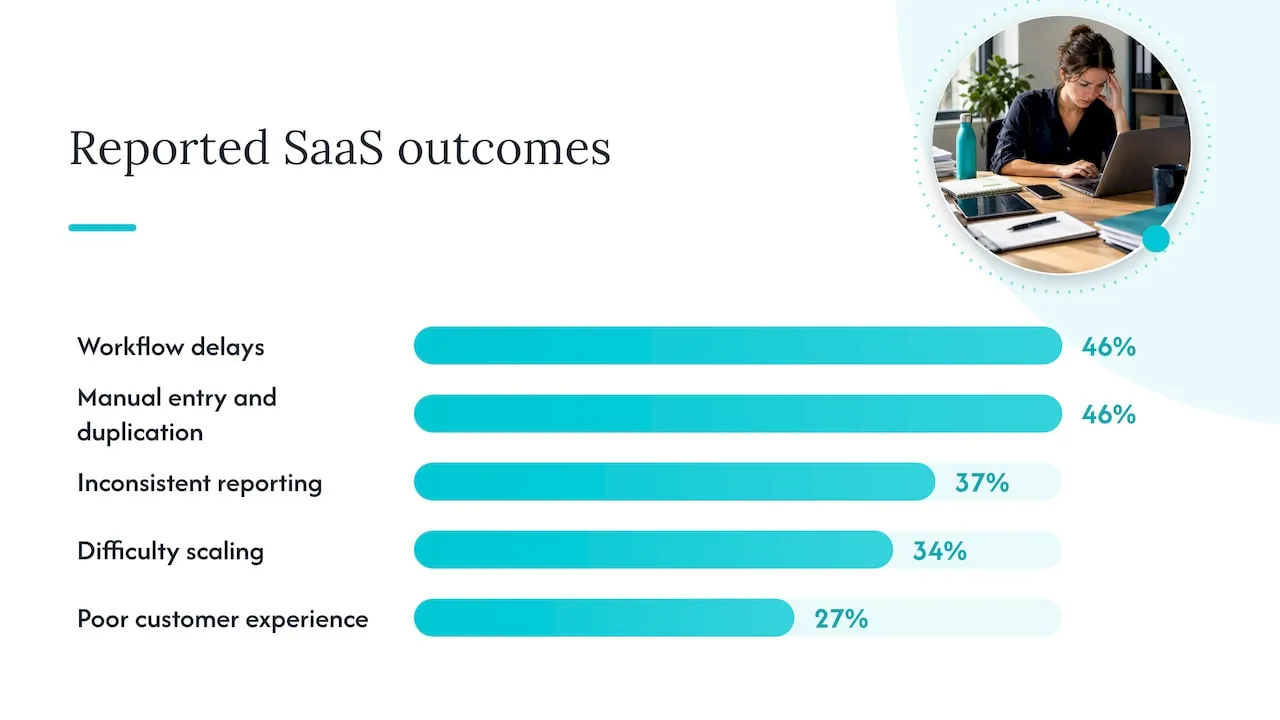
Operations. A 2025 survey by Nintex of IT leaders, published as The SaaS Sprawl Snapshot, reports that U.S. respondents cite workflow delays (46%), more manual entry and data duplication (46%), inconsistent reporting (37%) and difficulty scaling (34%) as direct outcomes. Another 27% blame disconnected systems for a poor customer experience.
Security and compliance. Tools nobody reviewed hold customer data nobody mapped. TechTarget notes that a lack of IT oversight raises the risk of breaches. For a European SaaS company, unmapped tools also make it harder to answer basic GDPR questions: where does personal data live, who can access it, and who processes it. This is general context, not legal advice. Your counsel or data protection officer should confirm what applies to you.
Decision quality. When revenue, churn and pipeline numbers differ by system, leadership meetings turn into arguments about which number is right. This cost never appears on an invoice, but it is often the largest one.
You will see sweeping industry figures on wasted SaaS budgets in many articles. Treat any single percentage with caution unless it comes from a named survey with a stated sample, and measure your own: licenses paid for against licenses used.
Data silos: the problem behind the problem
Search for tool sprawl and you will find advice about licenses. The deeper issue is that every tool keeps its own copy of the truth.
BCG reports that, as of 2024, organizations used more than 1,000 applications on average, and only 29% were integrated for data interchange. Those are enterprise-scale numbers, and a 100-person company is far smaller. The mechanism is the same, though: each new tool adds another place where a customer record can drift out of date.
Info-Tech describes what piecemeal integration produces: a fragile network of point-to-point connections that leads to siloed data and missed opportunities. Deloitte defines the result as inaccurate, inconsistent and low-quality data, higher maintenance costs and more complexity.
Why this matters more now that you want AI
Most SaaS teams already use AI assistants. What they find is that an assistant is only as reliable as the data it reads. BCG says poor integration limits the value companies can get from data, especially as decisions lean on real-time analytics and AI. Info-Tech cites a figure that 95% of IT leaders see integration as a barrier to AI adoption.
The practical version: if your CRM says an account renews in March, billing says June, and a spreadsheet says the customer already churned, an AI assistant will pick one answer and sound confident about it. Cleaning up sprawl is therefore the first step of any serious AI program, not a separate project.
How to find out what you actually have
You cannot manage what you cannot see. A workable inventory for a company your size takes days, not months. Pull from four places:
- Expense and card data. Search the last 12 months of corporate card and reimbursement records for recurring software charges.
- Accounts payable. List every vendor invoiced for software.
- Single sign-on and identity logs. If you use an identity provider, it shows which apps people log into.
- A short survey. Ask each department head to list the tools their team uses and who owns each.
For each tool, record the owner, the team using it, the monthly cost, the number of paid seats, the number of active users, the renewal date, what data it holds and which other tools it connects to.
The last two columns are the ones most inventories skip. They tell you whether personal or financial data is sitting somewhere unreviewed, and which tools would break something if you removed them.
How to reduce SaaS sprawl, step by step
- Name an owner for the whole stack. Someone has to be accountable across departments. In a 20 to 200 person company this is often the COO or a fractional leader, not a full-time IT team.
- Sort every tool into one of four groups: keep, merge, replace, retire. Decide by the job the tool does, not by how much people like it.
- Find the real need behind each tool. Teams rarely adopt a tool for fun. A Customer Success health-score tool usually exists because the CRM cannot show usage data. Fixing that gap is what lets you retire the tool.
- Retire in phases. Start with tools that have no active users, then duplicates, and leave integrated tools for last. Export data before you cancel anything.
- Pick the system of record for each type of data. Customers and pipeline belong in the CRM. Invoices, revenue and payment status belong in finance. Everything else reads from those two, rather than keeping its own copy.
- Add a light approval path. Block nothing, but require a short request: what problem, which data, who owns it. If the answer takes a day, people will use it. If it takes three weeks, they will go around it.
- Review quarterly. Check renewals 60 to 90 days ahead so you can decide before auto-renewal, not after.
A note on consolidation: replacing five tools with one platform only helps if the platform fits your governance needs and the metric definitions are shared. Otherwise you have swapped five silos for one big, confusing one. SAP makes a parallel point about integration tools, saying consolidating them can improve governance through centralized management of dataflows.
Start with the most expensive process
Info-Tech recommends focusing on high-value integrations and expanding step by step rather than connecting everything at once. We agree. Pick the one process where disconnected tools cost you the most, such as month-end close, renewal forecasting or customer onboarding. Fix the data flow there first, measure the result, then move to the next.
Where AI does not belong
Adding AI to a messy stack makes the mess faster. Be explicit about where it should not go:
- Over data nobody has agreed on. If two systems disagree about a number, resolve the disagreement first. AI should not be the tiebreaker.
- In place of decisions that need accountability. Pricing exceptions, refunds above a threshold, contract terms and hiring decisions need a named human who answers for them.
- On personal data you have not mapped. If you cannot say where customer personal data lives, do not point an AI tool at it. Under GDPR, the EU AI Act and, where it applies, NIS2, your obligations depend on what data is processed and how. Ask qualified counsel what applies to your case.
- As a replacement for process design. A broken handoff between Sales and Finance does not improve because an agent performs it. Fix the handoff, then automate it.
- Where an audit trail is required and unavailable. If an action cannot be logged and reviewed, it should not be automated.
AI belongs where the data is clean, the process is understood, the permissions are defined and a person can approve the sensitive steps.
Perspective: fix the foundation before adding agents
We see the same pattern in most growing SaaS companies. Teams already use AI, but nobody owns it, and the tools underneath it disagree with each other. Adding another assistant to that stack adds another copy of the truth.
That is why we work in a fixed order. First the data foundation: the CRM, the systems around it, and a Processor that turns the data into one agreed version of the truth. Then the AI layer, which connects that data to the assistant your company already uses. Only then purpose-built agents for Finance, Sales and Customer Success, which your people use in plain language to look up, report and update records within their permissions, with approval where needed and an audit trail.
We also adopt AI one process at a time, starting with the most expensive one. That keeps the work measurable and stops the stack from growing a new layer nobody understands.
Our approach rests on 25 years of running operations, so the strategy and the working system do not drift apart. GDPR, NIS2 and the EU AI Act are design requirements from day one, not a later review. Build, pilot and testing run on self-hosted European infrastructure in Germany, and you own what we build: source code, documentation and infrastructure transfer at handover.
Claus Nielsen
Where NordOps Consulting fits
If your inventory shows tools that overlap, data that disagrees and AI use nobody owns, the next step is a decision about where AI pays and what the data needs first.
NordOps Consulting is an AI consultancy that provides a Fractional Chief AI Officer for B2B SaaS companies in Europe. Our AI Readiness Assessment starts from €4,500 and looks at your data, your tools and where AI would pay first. If you want ongoing ownership, the Fractional CAIO retainer starts from €1,500 per month. You can also book a free 30-minute discovery call to talk through your stack first.
Builds are priced either as a fixed price agreed before work starts, or at 30% of the first-year saving once it is measured and proven. To see how the method works in order, read our AI adoption method, or see how the Processor creates one agreed version of your data. For governance questions, our AI governance framework is a good next read.
NordOps Consulting is not a DevOps or CloudOps provider, and does not manage your SaaS subscriptions or licenses. We work on the data and AI layer once you have decided what stays in your stack.
FAQ
What does SaaS sprawl mean?
SaaS sprawl is the uncontrolled growth of cloud applications inside a company, without enough visibility, ownership or governance. It is defined by the lack of management, not by the number of tools. A company with many well-owned tools is not in sprawl, while one with fewer unowned tools can be.
What is the difference between tool sprawl and SaaS sprawl?
The terms are used almost interchangeably. Tool sprawl is the broader phrase and can include spreadsheets, internal scripts and free apps. SaaS sprawl refers specifically to subscription cloud software. The cleanup method is the same for both.
How do I break down data silos?
Choose one system of record for each data type, usually the CRM for customers and pipeline and your finance system for revenue. Connect the other tools so they read from those systems instead of keeping their own copies. Start with the single most expensive process, then expand step by step.
How often should we review our SaaS stack?
A quarterly review works for most companies in the 20 to 200 person range. Tie it to renewal dates so you can cancel or renegotiate before a contract auto-renews. Add a quick review whenever a new tool is requested.
Does cleaning up sprawl make us compliant with GDPR?
No. A clear inventory helps you see where personal data lives, which supports your compliance work, but nothing here guarantees compliance. Ask your legal counsel or data protection officer what GDPR, NIS2 or the EU AI Act require of your company.
Sources
- IBM: What Is SaaS Sprawl?
- Shopify Enterprise: What Is SaaS Sprawl?
- Matrixflows: Reduce SaaS Tool Sprawl
- TechTarget: What is SaaS sprawl?
- Deloitte: Containing the chaos in your data ecosystem
- Nintex: The SaaS Sprawl Snapshot 2025
- BCG: Seven Questions for a Smarter Applications Strategy
- Info-Tech: Build an Enterprise Application Integration Strategy
- SAP: Rein in sprawl by consolidating integration tools